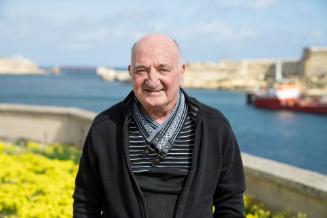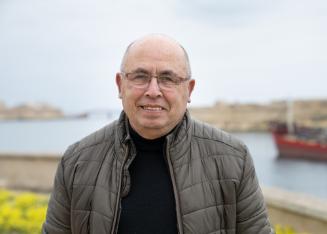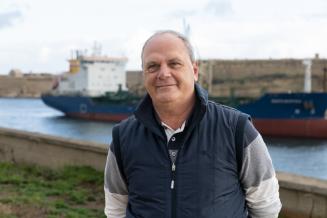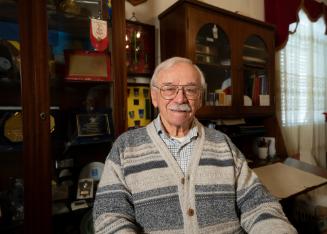


Oral history of the Malta Dockyard: Godwin Bonett
Interviewee
Godwin Bonett
Maltese, born 1941
Interviewed by
Joe Meli
Maltese, born 1953
Date13 May 2021
Classification(s)
Object TypeOral history
LanguageMaltese
Extent1 digital audio recording (WAV)
Registration NumberMMM.AV0036
DescriptionThis recorded interview was made as part of the Malta Dockyard Oral History project by the Digitisation Unit, Heritage Malta, under the direction of Joe Meli. Godwin joined the dockyard in 1956 when the yard was still under the Admiralty. During his apprenticeship, he experienced the transition to Bailey. He became a shipwright in 1962. He moved through various jobs up to a position of Chief Estimator until retirement in 2002.Transcript / Summary
(This summary is a work in progress. Timings are approximate.)
Special CollectionEntering the dockyard-Swan Hunter / Bailey / changeovers
(00:30) He used to attend the school of Mount Carmel. When he joined the Admiralty Dockyard, he states that they were 12,000 workers. He adds that when the Dockyard became commercial and the labour force was split, there were 6,000 with the Admiralty and 6,000 with Bailey. He wanted to join the Dockyard, since his brother already used to work there.
Education-Apprenticeship process
(04:30) He mentions that there were around 1,500 students that used to apply to join the Dockyard. And from these 1,500, the first 200 would be chosen as apprentices, and those to position between 200-250 would become yard boys. Godwin states that he placed in 121st position. The ones that place from 1 to 30 could choose electrical, then the others engine fitters, then shipwrights and those who were placed last, could chose civil engineering and pattern making. Bonett passed his exam and at the Dockyard technical college and he states that the shipwright training was very intensive.
(06:30) The first year was divided, 6 months working on wood and the other 6 months working on metal. At 15 years, he learned how to make a wood-joints (mincotti). In addition, in second year, they use to learn metalwork at a centre between No.4 dock and 5, The remaining 6 months used to be stationed at the boathouse with Sur Maggi.
Education-Dockyard school
(10:00) The work training time at the Dockyard was from 7am to 16:45pm. The lecturers that he had were commanders of the navy. He remembers various teachers who were all British. The school included learning subjects, including, Physics, Mathematics, English, Religion, etc.
Education-Dockyard school
(12:15) Bonett mentions that those first 200 students had to take an exam every 6 months, and the number was reduced through elimination of students who did not get enough marks. Godwin states that when a vacancy was issued and they used to apply, the first thing they were asked was for the four-year Dockyard school certificate-which was an asset during the interviews. As part of their training they used to do boats models, as well as tools both for woodworking and for metalworking. In the third year they would start going on board ships, learning and working with the instructor.
Entering the dockyard-Salaries, clocking in / out
(16:00) When he was a shipwright around 1962, his wage was £7/13s/6d (sebgha liri, tlettax-il xelin u nofs). He also mentions his wage when he joined as an apprentice in 1956; it was £1/17s/6d (lira, sbattax-il xelin u nofs). Then in his second year as an apprentice he was given £2/13s/6d (giex liri u tlettax-il xelin u nofs). At age 19, they got an incresae of 4s/6d (erbgha xelini u nofs).
Education-Employment pathways / local and foreign training opportunities
(17:45) During the rundown, the Dockyard Technical College came to an end as it stopped operating on May 1960. Bonett remembers that when he was at the Dockyard Technical College, the first three apprentices with the highest marks from the shipwrights, engine fitters, electricians would be offered to take part in the equal opportunity scheme. This meant that the first three apprentices of each section would be sent to England to work in an Admiralty Dockyard. By time the Admiralty stopped this scheme.
(21:00) Once he was going to Libya as a draughtsman, but he did not go due to family relationship matters.
Trade Union-Strikes
(21:45) The famous day of 28th April 1958, when the general strike took place, he was at the Dockyard Technical College. Problems arose and in fact, Godwin mentions when an Admiral and a fire engine were pushed into the sea.
Entering the dockyard-Swan Hunter / Bailey / changeovers
(22:30) One thing that affected the change from the Admiralty to a commercial Dockyard, was that previously for a Maltese to a higher level than a chargeman was practically impossible. They did learn a lot under the British, both skills and education. However, he argues that they only push you forward until up to a chargeman level, but not more than that.
Entering the dockyard-Swan Hunter / Bailey / changeovers
(23:30) It was in 1959 when the Dockyard shifted to a commercial operation and several opportunities were available to the workers. In fact, many Maltese became inspectors, foreman, manager, Hull manager, etc.
(24:15) He states that after finishing his apprenticeship, he became a shipwright, and later on a shipwright liner, then a draughtsman, then he moved as an estimator and then was promoted to leading estimator, and finally he became a chief estimator.
(26:15) When he was working on estimating, from the mid-1960s, he had opportunities to travel abroad on short visits to carry out ship inspections, and prepare estimates of the work required.
(27:30) One major work he carried out when he was an estimator, was on a ship named Woodburn in No.2 Dock, which had about 470 tons of steel renewals.
(28:30) Another major work was that of the Agip Genova, which exploded in Libya while it was sailing towards Augusta. John Darmanin (Laboratory) and Joe Mifsud (Dilinger), including Bonett were asked to take some notes about it and spent till 11 pm doing sketches. He calculated the weight of 810 tons. This was a very high value repair. The Owners’ representative wanted to get the ship inside Malta on the same day to start repairs, otherwise he would have gone to Italy. The final renewed steel weight was 1,100 Tons.
(39:45) He states that if he was sent to work abroad it would have been better for him, since he would have obtained better qualifications.
Malta Dockyard Oral History project
Dimensions43 minutes 58 secondsProvenanceRecorded by Digitisation Unit, Heritage Malta.Online Collections
Public Access
Not on viewMuseumMalta Maritime Museum
Location
- Malta Maritime Museum, Reserve Collection