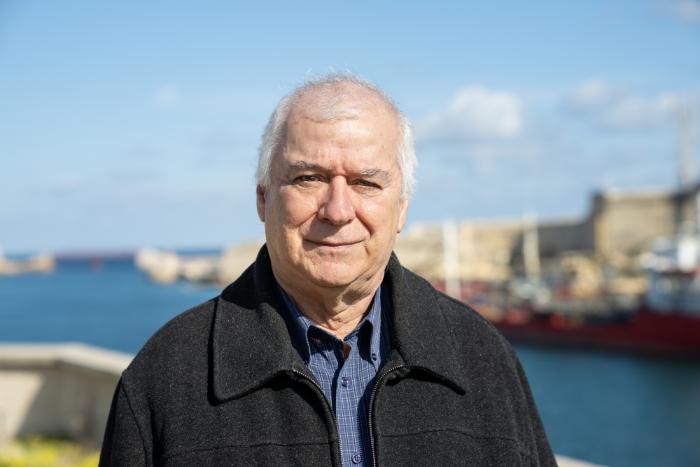
Oral history of the Malta Dockyard: Reginald Salnitro
Interviewee
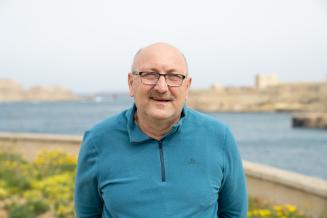
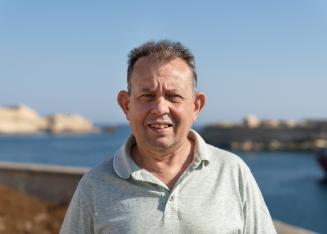
Reginald "Reggie" Salnitro
Maltese, born 1949
Interviewed by
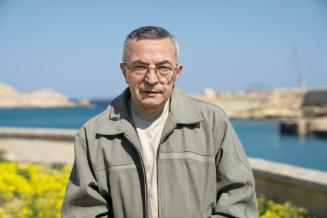
Joe Meli
Maltese, born 1953
Date18 May 2021
Classification(s)
Object TypeOral history
LanguageMaltese
Extent1 digital audio recording (WAV)
Registration NumberMMM.AV0038
DescriptionThis recorded interview was made as part of the Malta Dockyard Oral History project by the Digitisation Unit, Heritage Malta, under the direction of Joe Meli. Reggie joined the shipyard in 1966 as a Blacksmith apprentice. He completed his apprenticeship in 1970 and started working as a tradesman at the smithery. He eventually moved to a position of assistant planner with the Planning department and left the yard in 1997 for another job opportunity.Transcript / Summary
(This summary is a work in progress. Timings are approximate.)
Special Collection(00:30) They started out, in the first year, training on all the main trades found in the dockyard, starting from the lathe work, machining, steelwork, electrical, bench fitting, pipe work, wood work and so on. In the meantime, they were also having lessons in the technical institute, while going around the workshops within the dockyard, based on steel working, which included the shipwrights, blacksmith and boiler makers. He and 5 other apprentices were sent with the blacksmiths, where in the end it was just him and two others as the others had found other employment opportunities outside the dockyard.
After four years, he successfully passed the trade test to become a tradesman. For the test, they had to do the binding of a wood block (parankett) which was fabricated from a solid piece. And they also had another test where they had to fabricate a water tight door clip including the handle.
(04:00) After that, they then became tradesmen and, in his case, he spent the first few years working on the forge where they worked on items such as brackets, fabrication of bollards and hatch doors. After some time, he was asked whether he wished to continue in the shop or do afloat work, and he chose to join the afloat gang of the chargeman Joe Camilleri, who was Reggie’s instructor during his apprenticeship. Joe Camilleri eventually became foreman.
Entering the dockyard-Trades (From approval to the departure of a vessel)
(05:00) Here they worked the ship chains and anchors. This involved calibration of the anchor chains, including laying of the chains on the dock floor, mark it from shackle to shackle which was around 15 fathoms. This was a length of chain of about 90 ft.
(05:30) There were two main types of shackles that connected from one end to another: the first type was the lugless shackle (a machined shackle that opens in two halves), with a chock in the middle. To open the chock, they had to remove the retaining pin, which required heating and driving out with a sledge hammer. The second type was the lug shackle known also as “d-shackle”. This was big in size, with an elliptical bolt.
Entering the dockyard-Trades (From approval to the departure of a vessel)
(06:30) They would mark, for each length of chain, the shackle with a red paint and adjoining links (malja; Plural: malji), on each side of the shackle with white paint. They used to mark the chain with either using seasoned wire or copper wire / canvas or a bended strip of stainless steel, depending on the requirements of the ship’s crew. Sometimes they would coat it with fish oil or a solution. Sometimes they also had to stay in the chain locker to position the chain by hand as it is lowered in. This was a dangerous operation, and they had to be extra careful, as one bad movement, could seriously injure their legs.
(07:30) In the chain locker, there is also the end shackle which is fixed to the chain locker structure. Sometime they were instructed to do a transposition of the chain, which meant inverting the chain connection from the anchor end to the chain locker end. This was done because the part of the chain on the anchor side wears much more that the part of the chain connected to the chain locker end. Sometimes they were asked to chip the chain to remove the loose rusted parts from the links using the chipping hammer.
(09:00) The trade of the smiths also included the locksmiths, who worked on any work requirements on locks including fabricating keys for locks. He remembers Philip from Senglea who was a craftsman on this work, he could open any lock and then fabricate a key for the same lock.
Safety-Health and Safety procedures
(09:30) Other work by the smiths was the derrick (boom) work. He enjoyed doing this work, with all the challenges it came with, especially when it came to the jumbo derricks, which had a lifting capacity of up to 100 tons. These derricks were commonly found on the Concordia vessels. The challenges included in the removal and refitting of the cable wires that passed through all its blocks. The smiths had to remember how paths and connections of these cable wires. This was dangerous work due to the height they had to work at. The safety equipment that they had at that time was quite basic, as compared to the modern harnesses used nowadays.
(11:15) To remove the blocks from the derricks, they first removed the wires. There were times when they had to heat the pins for removal. Furthermore, it also had a swivel/hinge mechanism (for the derrick to move from side to side), which sometimes required checking due to some restricted movement problem. The same procedure of heating was involved for removal. The removed blocks are then sent to the testing house, where they are opened for cleaning (petroleum or diesel), checked for damage and repaired as required. There are renewal of bolts, split pins, bearings, bushes and grease nipples (these are also sometimes clogged with grease and rust constricting flow).
(14:00) When the work on the derricks is completed, these were subject to be surveyed for certification. The certificates were issued by the Classification Society. There was also an Australian certification, which was to be more precise and to perfection, in the sense that everything had to be placed back in its original place within the same derrick otherwise they would have re-do the work.
(16:15) The Dockyard plant cranes were not under their responsibility. This work was done by the plant department with the fitters and riggers.
(16:30) He remembers once on the Concordia Sun (ship manager David Azzopardi) where they needed to remove the derricks (by the fitters) to check the lower heel pin and as they were installing it back in place, the block was fitted in the wrong way. When this was noticed, the vessel had to leave urgently, so they had to do the job during the night, which made it even harder due to the restricted space in which they had to work. Thankfully they managed to do a good job and prevented unnecessary expenses for the dockyard.
(18:45) After all the work done on the derricks, the next step was to test them. They used a dynamometer which was attached to a bollard and the derrick would then pull to the certified load. Alternatively, they used calibrated weights (castwalli). Here he remembers how one time, a vessel at Hamilton Wharf, which had mini jumbo derricks (handling 35 tons each) situated in the middle of the deck and the dead end of the wire was not connected as it normally connected. They were testing it with calibrated weights, and the chief officer that was operating the derrick was giving it jolts. The yard personnel brought this to his attention. He still continued the way he was working and the result was that the bulldog clips broke and the weights fell on and damaged the jetty.
(21:15) The vessel he remembers very clearly was the ship British Wasa (Ship manager was George Madden). The work on the derricks of this ship was very dangerous. There derricks were removed and rested on their support on the ship hold (stiva) and on each side of the boom it had two blocks with swivels, which needed removal. To remove these, they had to work on the derricks with the hatch covers open, with other workers working under them inside the hold. Today, if he had to go back in time and had to do it again, he would think twice before going ahead with it due to the dangerous environment for him and his colleagues.
(23:30) The derricks differed in diameter, depending on the vessel type and size. They varied from one foot to ten feet in diameter.
(24:00) He remembers one day when he worked on the 1st of May, which was a holiday and at the time he was not home as he was spending time with his family. When he arrived home, he found a note that they needed him to go to the yard because of an emergency. When he called the yard to check what was the problem, the ship manager told him, that since he was the one in charge of the particular job, they needed him to complete the work as the vessel, an Algerian vessel, needed to leave on the day.
(28:30) When he worked in the workshop, everyone was specialized in particular work, such as heavy forging work such as coupling bolts of three to ten inches diameter made from EN8. Some were made complete with a nut head or round. These had to be forged not just bent, depending on the usage. Bracket/saddles, U-brackets (work made to measure), stanchions for the pipes railings and forged stanchions using round bars or sometimes flat bars. They used to make bed-steads for scaffolding. They also worked on fabrication of hinges, and other various work at the Marsa power station, such as pillars, and special beams.
(39:30) The smiths also worked on spare anchors, which are jammed due to non-usage. Since it is stored on deck and is continuously subject to the weather conditions. They would remove the spare anchor from place and transport to the workshop where it was placed on two large mobile forges. One forge heating the flukes (nappi) and the other forge heating the shackle part. Sometimes they were able to free it up with the force of a sledge-hammer. Whereas, when the connection is difficult to release, they had to add weights on the flukes until these free-up. Once released they would cool the anchor and carry out any required repairs, they would then grease the connection and taken on board again.
(42:45) Repairs on the anchor included the trunnion pin (which holds the shank with the flukes) which most of the time is wasted. There were two types of pins. One type was a through-pin with hammered bolts fixing it to the flukes. The second type were called (kanuniera bil-furficetta), where the shank would have a pin (bolt) at the base of the anchor and then it would have two U-shaped blocks (kanunieri), and insert a hot flat bar and flared in place to lock the shank.
Other work included the renewal of a worn-out shackle pin. This is be removed using heat and sledgehammer. The anchor would be positioned upright using metal blocks to hold it in position. The pin is forged inserted in place when it is red hot, where it is sledge hammered in place. This process generally required about three workers hammering it in a synchronized way for a continuous hammering, so that the pin fits in place before cooling.
(46:00) When it came to forging, they also used to make gear wheels. The process started with the shaping of a blank forging (Ftajjar). The base material required to do the blank forging is calculated according to the gear-wheel final measurements (diameter and height). These are then sent to the machine shop for the final machining.
They basically use mathematics to know how much to flatten, volume and shape. They used a steam hammer to flatten it, while the smiths would turn the forging using thongs, so that the final shape is even. The hammering needs to be constant whilst the forging is still hot. The blacksmith co-ordinates the operation with the steam hammer operator, who has the knowledge of the tempo and the force required by the blacksmith.
Other fabrication work included, ladders (skajjel) made from square, round or flat bars, depending on the requirements. They also manufactured manhole covers for the dockyard, as well as for ships. They also fabricated ladders (skalapiza) done using expanded sheets and bulb plates on the sides or square bars or plates.
Looking back-Reflections
(53:00) He concludes that the time he spent at the dockyard made him the person he is today, even though he left early from the dockyard for another job opportunity. He feels as though he was born in the dockyard, even if, when he started at the smithery, he did not like the workshop and the trade but then grew to like it. He recalls the decorative lighting poles around Malta, were fabricated in the yard. Various other jobs for the government, waterworks (brackets/saddles), China dock (pickaxes, hatchets, pumping station doors) and various other works that not that many people know about or give attention to.
Malta Dockyard Oral History project
Dimensions56 minutes 34 secondsProvenanceRecorded by Digitisation Unit, Heritage Malta.Online Collections
Public Access
Not on viewMuseumMalta Maritime Museum
Location
- Malta Maritime Museum, Reserve Collection