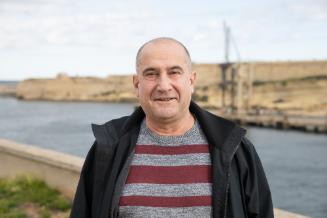
Oral history of the Malta Dockyard: Joe Vassallo
Interviewee
Joe Vassallo
Maltese, born 1959
Interviewed by
Joe Meli
Maltese, born 1953
Date16 November 2021
Classification(s)
Object TypeOral history
LanguageMaltese
Extent1 digital audio recording (WAV)
Registration NumberMMM.AV0089
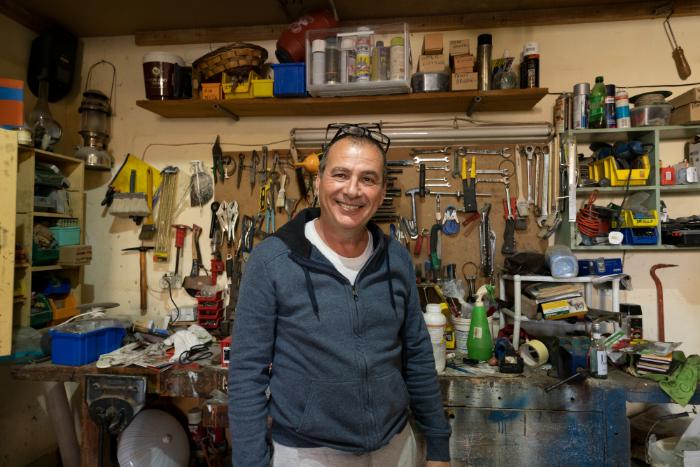
DescriptionThis recorded interview was made as part of the Malta Dockyard Oral History project by the Digitisation Unit, Heritage Malta, under the direction of Joe Meli. Joseph Vassallo joined the yard in 1977 and following the completion of his apprenticeship, worked in the Machine shop for the remainder of his Yard life and ended only through the Yard closure in 2010 when Joe was a Chargeman of fitters.Transcript / Summary
(This summary is a work in progress. Timings are approximate.)
Special CollectionEducation-Apprenticeship process
(00:30) He entered the dockyard on the engineering trade because he had spent four years at trade school studying mechanical engineering before entering the dockyard. After finishing trade school, he had the opportunity to choose a place of work related to the craft he was studying. Once he entered, he spent another three and a half-year as an apprentice on engineering. Initially, this consisted of an introduction to the main trades of the yard, such as sheet metal, wood working, electricity, welding, smithery, etc. On completion of the first year, the apprentices were assessed and guided to the trade appropriate to each individual apprentice. Since he had already studied the craft of mechanical engineering, he and another four apprentices were allocated to work at the factory, also known as the machine shop. They spent the other two and a half year of their apprenticeship visiting various sections related to engineering work.
(04:15) The first thing he recalls when entering the factory for the first time, was the amount of people working there. He recalls that there were about 280 people divided into different sections. There were 5 sections of bench fitters alone.
Education-Interesting training and skills
(08:00) At the end of his apprenticeship, he was sent to work on the heavy lathe, which was very interesting and demanding. The work also carried a lot of responsibility, as this involved machining of very expensive items, and any mistake can be very costly. The biggest lathe, manufactured by Cerutti known as ‘it-Taljan’, was of 16 metres between centres, with a centre height of 23 inches. There was also another lathe known as the ‘Swift’ which was 14 metres between centres and a centre height of 38 inches. These lathes were used a lot and constantly busy with work.
Education-Interesting training and skills
(11:00) He recalls that one of the most difficult work he did on the ‘Swift’ lathe was a steam turbine shaft which weighed a total of 35 tons. This was to the limit of the lathe and cranage capacities. There were other big works, that were required by government departments, such as the machining of the decorative lamp-posts.
(15:30) The machine shop, had various other sections, each specialising in particular machining and/or hand work. The workers in the different sections were specialists in their allocated tasks. Amongst various section he mentions the tool-room, that had the ‘standards-room’ which had a constant temperature of 20/21 degrees, where special calibrated tools were stored and maintained. There was also the pump room where the overhauling of diesel pumps and injectors were carried out. All the machinery in the factory are quite old and they all required specialised people to operate.
(23:15) He recalls that the use of the capstan and turret lathes was already decreasing 40 years ago since they are mainly used for the purpose of production. Although they are still in use for standard work, they were more popular during war times.
Education-Interesting training and skills
(26:00) He describes the process of the renewal of the wood bearing of the tail shaft on old ships. Firstly, they would be provided with the measurements of the hull bush without wood. Then, they would look for available bushes having the nearest dimensions.
The chosen bush would be machined to exact measurements of the ship stern tube. This is used as a dummy of the ship’s stern tube. The patternmaker prepares the wood to be fitted, and the wood is machined to the final dimensions of the shaft diameter. Once machined, the wood was marked and installed on board.
(30:30) He recalls having heavy lathes which were not as big, around 3 or 4 meters between centres. A lot of the work was presented by crane. He got used to his job with time and experience.
Life after the Dockyard-Finding a new job
(31:30) As soon as he retired from the dockyard, he spent about three and a half months registering when an application was published for a two-week job at Palumbo, which he applied for and eventually was chosen. From the two weeks, he stayed in the yard for further years up to retirement.
(34:00) An important episode he remembers concerning heavy lathes is when he was appointed as journeyman. This work was on a turbine. This work was carried out by an American expert and Joe was assisting him. There was a mistake concerning a journal that was over machined. This provoked a panic as this was work for the Malta power station.
Malta Dockyard Oral History project
Dimensions37 minutes 44 secondsProvenanceRecorded by Digitisation Unit, Heritage Malta.Online Collections
Public Access
Not on viewMuseumMalta Maritime Museum
Location
- Malta Maritime Museum, Reserve Collection