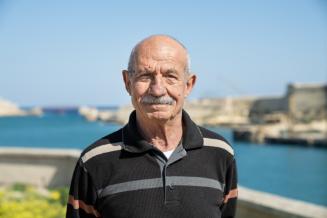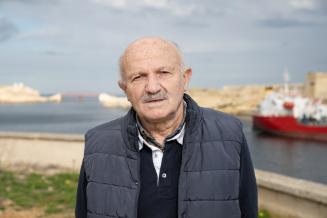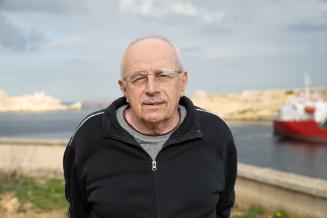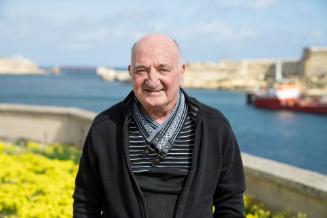
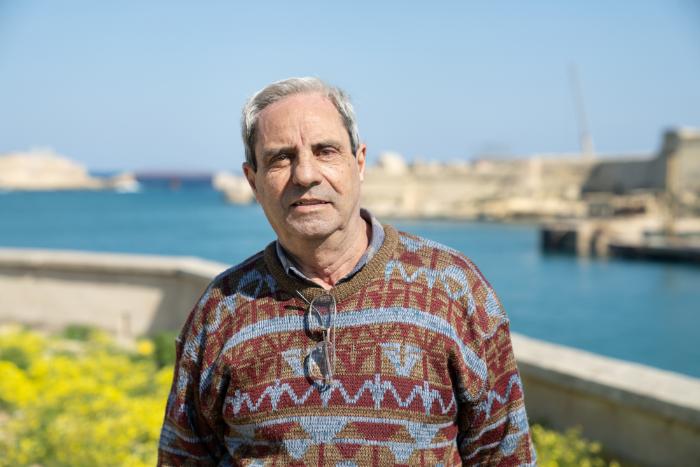
Oral history of the Malta Dockyard: Rennie Busuttil
Interviewee
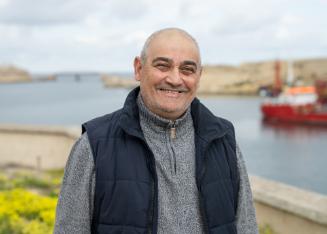
Nazzarenu "Rennie" Busuttil
Maltese, born 1952
Interviewed by
Joe Meli
Maltese, born 1953
Date1 July 2021
Classification(s)
Object TypeOral history
LanguageMaltese
Extent1 digital audio recording (WAV)
Registration NumberMMM.AV0052
DescriptionThis recorded interview was made as part of the Malta Dockyard Oral History project by the Digitisation Unit, Heritage Malta, under the direction of Joe Meli. Rene entered the shipyard in 1969 as a shipwright apprentice. On completion of his apprenticeship, he worked with the Shipwrights’ afloat section on new building work. In 1984, he was sent to the Marsa Shipbuilding. In view of a typical situation that existed between the Malta Drydocks and Malta Shipbuilding in the late 80s, he joined Malta Shipbuilding in 1987 as a foreman of shipwrights. He left the shipyard in 2003 with an early retirement scheme.Transcript / Summary
(This summary is a work in progress. Timings are approximate.)
Special Collection(00:30) He entered the dockyard in 1969. He had already passed from the exam a year before but due to his ranking and the amount needed in the dockyard he had to re-sit for the examination later. In the meantime, as he was waiting to enter the dockyard he worked as a pipe worker with the government. When he entered the dockyard, the system was that the apprentice selected his trade before starting the training. Even though he would have liked to go as a pipe worker, due to his ranking in the exam, he had to choose the trade of a shipwright. He had his uncle as a shipwright’s foreman (Tarcisio Darmanin), plus other family members who worked at the dockyard as well.
(02:30) The first year of his apprenticeship was passed at the training centre, where he gained different skills of the main trades of the dockyard, which he still uses up to this day. He added also how meaningful this period was because it was like school, which is something that no workplace, including Palumbo who took over the dockyard, can offer nowadays. The instructors and their teaching were excellent and to a very high level. Unfortunately, during his apprenticeship, there was the 6-month strike in the yard and he lost the training at the Manoel Island Yacht yard. Instead, he spent the period at the boilershop. The next training was with the afloat section with chargemen Mr. Magro and Mr. Cachia at the No.1 Dock. At that time there was a shift system in the yard.
Entering the dockyard-Trades (From approval to the departure of a vessel)
(06:00) At the No.1 dock, he joined the gang of Mr. Magro, who was the chargeman working on the coasters. The project was the new building of small vessels, also known as coasters. These were built in parts in the dock. At that time the working drawings were done at the mould loft in full scale.
Entering the dockyard-Trades (From approval to the departure of a vessel)
(06:30) The mould loft was a place used to lay down the full-size shape of the ship. Moulds and templates are done for every structural unit for building. At the time, there was no tenth-scale drawing system available, so they had to do everything in full scale. For example, a frame (majjiera) of a vessel had to be drawn on the floor of the mould loft and a template is made to fabricate and shape the steel frame. At that time the system for building the ship was that each structural item is assembled individually in dock. Eventually the system evolved and the ship was divided in blocks, which were built in the shop, and assembled in the dock.
(08:00) Continuing on the new building of the floating dock, he was still an apprentice at the time and his chargeman assigned him work as a checker or a liner, where he was responsible of the material. Sections of the floating dock were built on No.1 dock. They had some technical problems on the alignment. This was mainly due that assembly work was being done afloat.
(09:30) Other work that he was involved in was fabrication of buoys. Different types of buoys, as the SBM (Single Buoy Mooring) buoys that handled liquid cargo. He remembers one of the big projects having a hexagonal shape (refers to Tazerka base). This required different working procedure, and they were not allowed to weld any temporary material to its steel structure.
Apart from the above, they also had works on the Ta’ Qali Stadium grandstand cover, the shipbuilding fabrication shop roofing and the extension on the pre-fab shop roof.
(12:15) Other new building works were the tug boats, the Chinese tankers, which were done in No.1 dock, that was converted for Ship building.
(12:45) In 1984, he was sent to the Malta Shipbuilding to work on the silo project and stayed there longer to help train some of the people who had entered to work at the shipbuilding to work on the two Chinese tug boats and the eight Russian vessels. He was working there as shipwright and a checker.
As a checker, he was responsible of the steel required for the work and also co-ordinating the drawing office and the work shop. The foreman would tell him which part of the vessel they will be working on and he would then check the steel material available, and co-ordinate the drawings required for the part required by the foreman.
(16:30) As they were located at Marsa and not at the dockyard, they were considered as if they betrayed the dockyard by going to Marsa. In fact, they were only seconded by the dockyard to the shipbuilding yard. Obviously, their experience gave then more promotion opportunities in the new Marsa yard. He was a shop steward, as well as a secretary with the workers committee. In fact, after sometime (about 1987), he applied for a foreman position, for which he sat the required examination and was promoted as foreman with the Shipbuilding. This meant that they had to change company from Malta Drydocks to Malta Shipbuilding. This was complicated, as the Union claimed that the application call for foremen, should have been open to anybody outside the Malta Shipbuilding and should have been an external call.
(22:45) The workers at the shipbuilding were still willing to learn, even though some of them did not have an apprenticeship comparable to the one at the Drydocks. At the time, they were employing a lot of people with the shipbuilding.
At the shipbuilding, there was not as much work variety as there was in the Drydocks, so mainly they had to learn and strengthen their skills within their particular position, especially considering the time constraints to do the amount of work that there was.
(25:30) Here he added that, although they were now Shipbuilding employees, they were never fully accepted by the shipbuilding people as they were still considered as drydocks workers. This caused him a lot of problems, even if he tried to help them out as much as he could, he still carried, to a certain extent, the drydocks label.
(26:45) Certain works at the shipbuilding yard that required the use of specific machinery, workers from the shipbuilding were sent to do these works at the drydocks so that they get the necessary practical experience.
After some time, these workers gained the experience and all the work started being carried out in the shipbuilding.
(28:00) After the collapse of the Soviet Union, the Russian vessels project was affected. When the project started, there were Polish representatives assisting the drydocks drawing office. Nazzareno and his team co-ordinated with these people, this was before he became a foreman. There were also a manager and two foremen from Appledore to assist with the project. The co-operation between them was very good.
(32:45) When he became a foreman, he was in charge of the workshop. At that time, the structural work on vessels Hull 167 & 168 was completed and the hulls were moved from the dock to the outfit-wharf, for outfitting work. This presented some management problems. Eventually the system was organised with a different foreman being responsible for specific areas of the work.
(38:00) There were also the Chinese projects consisting of two tugboats and other trawlers. At one point though, he was transferred to assist with the EneMalta conversion from coal to oil fuel system. This was a big challenge for him due to the difficulties in the installation of the materials / equipment, but it was successful and he was satisfied with his work.
As he was finishing with the EneMalta project, there were some issues between the shipbuilding and management. He was called back to the Shipbuilding to take over the Chinese vessels project. There was a lot of pressure from management (Mr Zammit-Chairman) to complete these Chinese tugs.
After completion of the Chinese project, the Russian project re-started and he was transferred back to the Russian vessels project.
(40:45) When he started working on the Russian vessels, he recalls that at the time there was no project manager in charge and the vessel was in a bad condition. In fact, there was a rat infestation that might have also affected the electrical and electronics systems.
After that, management asked him to go to the store to check what materials they had available. As he was doing the work and waiting for the security to open the store, the chairman (Mr Albert Mizzi) was visiting the area and saw that there was no one at work and he reported everyone including him, that they were not doing their job. He got a suspension due to this.
(49:00) He was involved in the work on the largest tank in Kordin. Actually, he filling in for another foreman, which made him feel like he was just there to fill gaps and management was taking advantage of him.
(50:15) Once again, he was called to replace the foreman that worked in the workshop to take care of the trawlers project. He was in charge of the whole shop, including welders and the pre-fabrication work. After all this, he was being considered to be promoted to a managerial position. However, just after two weeks, he was removed from the trawlers project and sent on the Gozo channel vessels project.
(55:00) When the shipyards dismissed 900 people, he was one of them and was given a job with the public service, assigned to the public library, this was in 2003.
Even during this period, he was still labelled as a dockyard worker, which was a disadvantage to him when it came to how people treated him.
In fact, before the job at the library he was working with Zabbar local council and he finished working as a sweeper for a month. It was only when he spoke up that he was supposed to keep his ranking of a foreman, that he was transferred to the public library.
(57:30) While he worked on the Gozo channel vessels, the last job he worked on was on the vessel ‘Ta Pinu’ because afterwards they removed him and his team from his project. He was left for around four years doing nothing with no place to go, not even a space to change his clothes. After that, in the 2002-2003, he was part carried on some small miscellaneous jobs, including work on the USS La Salle and as project manager on a yacht.
Malta Dockyard Oral History project
Dimensions1 hour 14 minutes 40 secondsProvenanceRecorded by Digitisation Unit, Heritage Malta.Online Collections
Public Access
Not on viewMuseumMalta Maritime Museum
Location
- Malta Maritime Museum, Reserve Collection