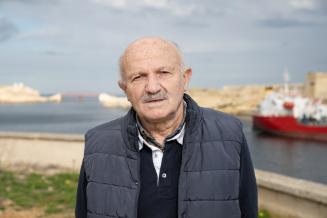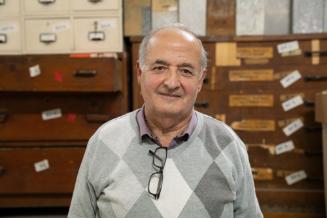
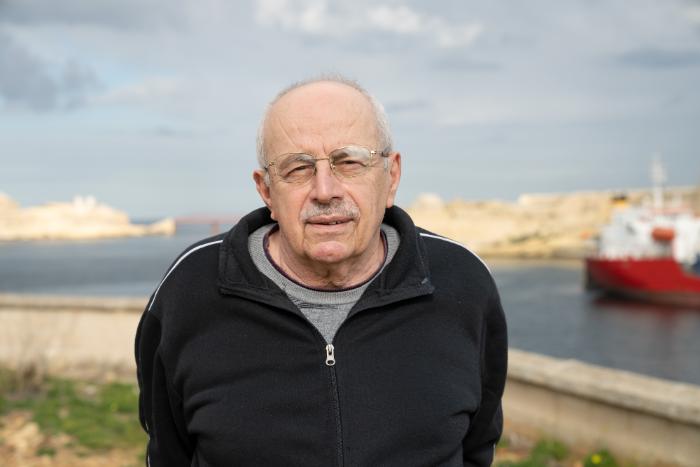
Oral history of the Malta Dockyard: Matty Saliba
Interviewee
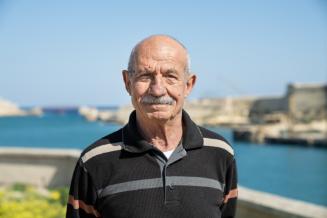
Methusalem "Matty" Saliba
Maltese, born 1948
Interviewed by
Joe Meli
Maltese, born 1953
Date7 July 2021
Classification(s)
Object TypeOral history
LanguageMaltese
Extent1 digital audio recording (WAV)
Registration NumberMMM.AV0056
DescriptionThis recorded interview was made as part of the Malta Dockyard Oral History project by the Digitisation Unit, Heritage Malta, under the direction of Joe Meli. Methusalem Saliba (aka Matty) worked at the yard between 1964 and 2008. He first worked as an Electrical fitter, then changed jobs totally to work as a recorder. He then applied and was chosen as an estimator with the New Building section. He eventually moved as a Shiprepair Manager before retiring in 2008 during the closing down process of the shipyard.Transcript / Summary
(This summary is a work in progress. Timings are approximate.)
Special CollectionEducation-Apprenticeship process
(00:30) On 7th September 1964, at the age of 16 he joined the Dockyard as an apprentice. He started as an electrical fitter. The first year he spent it at the training school, where they learned several skills. After a year, they were sent to do production as apprentices. At the same time, he attended school, as he had three days at school and two days working.
Education-Apprenticeship process
(01:30) In 1964, the Polytechnic opened and he started a technician course, known as OTD. After four years he sat for the test to become a journeyman, where they were given a test as electricians, and he was successful. The exams to enter the yard included an aptitude test, intelligence test, an interview and a medical test at Bighi Hospital.
Education-Apprenticeship process
(03:00) Then after five years he became an electrical fitter. He had to choose whether he wanted to work with the afloat section or work in the workshop. He opted to go working with the afloat section. He was stationed at No.1 Dock, where the submarine repairs sections were stationed and all electricians were there too.
Safety-Health issues (noise, risks)
(03:30) The standard of hygiene was not so good, and in fact he states that they had no showers and the place was invaded with cockroaches.
Education-Employment pathways / local and foreign training opportunities
(04:00) After some years as electrician, he tried to advance his position and applied for a post of a recorder. There were a lot of applications and only 20 were required. He was successful and spent two/three years as recorder. In the meantime, a vacancy for an estimator was issued, and he was selected. He spent 2 years in the shiprepair manager, then they were transferred to the new newbuilding section and eventually moved to Marsa shipbuilding, where the newbuilding yard was at its starting stages.
Saliba stated that he was not happy working at the Marsa yard. As a result, he was applying for various vacancies and applied for a trainee as shiprepair manager. He was chosen and spent the first 2 years training. Furthermore, he was sent to work on ships on his own, tasks, and in no time, he became a shiprepair manager.
Entering the dockyard-Trades (From approval to the departure of a vessel)
(07:00) The job of a ship manager was described as interesting by Saliba. He states that when the ship is about to arrive at the Dock, the senior shiprepair manager calls you and gives you the master file of the ship. Meanwhile Saliba went through the file to get acquainted with the requirements of the work. He then follows when the Superintendent is about to come. He also looked at the defect list and check each and every item. In general, he always worked well with the superintendent of the vessel.
During the repairs the shiprepair manager reported on a daily basis on the work progress to the top management, where the decisions on priorities were given.
The shiprepair manager also worked with the planners, estimators and shiprepair accountants, so as at the end of the repairs the superintendent was presented with the final invoice.
Entering the dockyard-Trades (From approval to the departure of a vessel)
(11:15) A planner is also involved before the ship arrives. They prepare a bar chart plan, and the progress of the work is followed in line with plan, adjusting as required to meet the completion date.
(13:30) Saliba recalls when once they had an equipment which cost about 1 million, and it fell into the sea. The Superintendent came on-site and told them, that accidents do happen. He adds that he never had serious accident on his ships, but only slight injuries.
(15:15) During his time working as electrician, they used to work with pyrotenax, which was a fire-proof cable made of copper covered with asbestos and the electrical cable passing through the inside. And once they had a ship full of pyrotenax cable, and the ship owners decided to remove all the cable, as they were having a lot of problems due to humidity. The workers doing the work were exposed to asbestos. Saliba mentions that one worker died because of asbestos. By time, this type of cable was condemned.
(16:30) During the last year as an apprentice, they did a project with the assistance of their instructors George Sharples and Salvu Attard. The project was to do a model of the world with lighting, but unfortunately the world failed to turn.
Entering the dockyard-Reasons for joining
(16:45) He attended De La Salle, and obtained 6 O-Levels. Saliba argues that at that time, with the certificates he had, he could have started training to become teacher, which required only 5 O-Levels. But he used to pass near Dockyard 4 and 5 on his way to school, and he decided to join the yard.
(18:15) A major accident he remembers is when, Buttigieg was welding and by mistake they opened water on him. He also saw the accident of the driller of the pre-fab, where the drill encircled his clothes. As shiprepair manager, he worked also during night-shifts. He mentions an accident on a ship at Parlatorio Wharf when he was on night shift, and the ship lost its moorings due to high winds.
(23:30) Saliba states that in the yard one learns a lot of new things, just by asking and following what work is going on. The experience itself was satisfying and he stated that the wage earned was good enough. Saliba regrets that Dockyard closed down.
Malta Dockyard Oral History project
Dimensions26 minutes 39 secondsProvenanceRecorded by Digitisation Unit, Heritage Malta.Online Collections
Public Access
Not on viewMuseumMalta Maritime Museum
Location
- Malta Maritime Museum, Reserve Collection