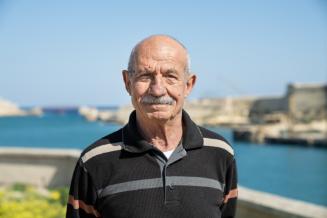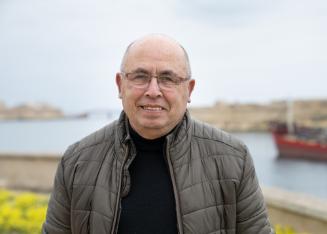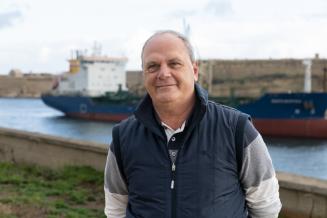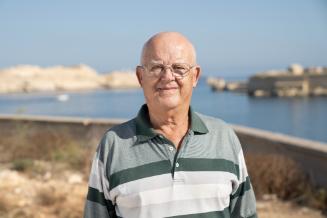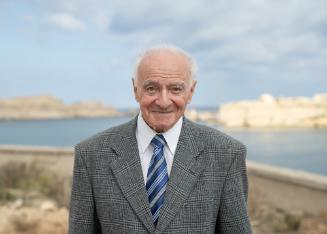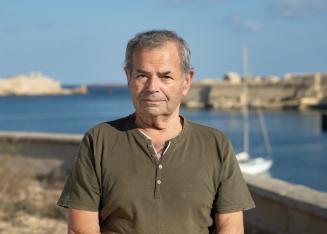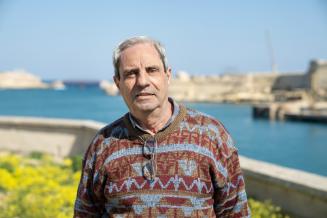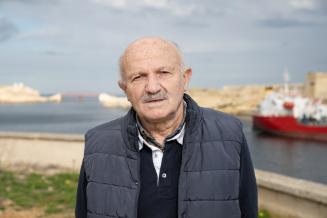
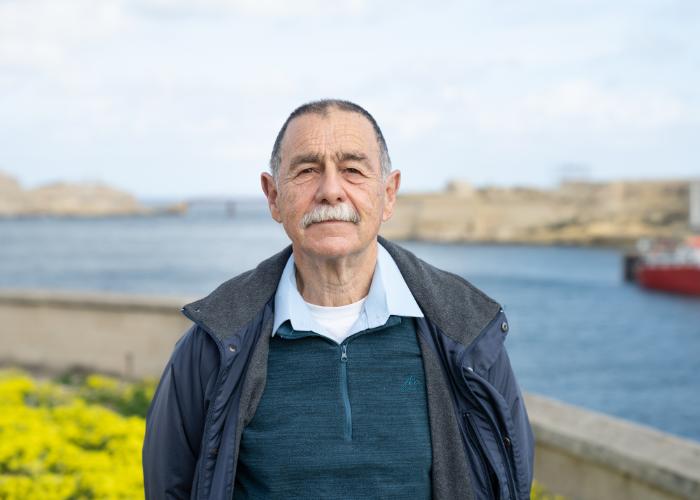
Oral history of the Malta Dockyard: David Church
Interviewee
David Church
Maltese, born 1956
Interviewed by
Joe Meli
Maltese, born 1953
Date6 July 2021
Classification(s)
Object TypeOral history
LanguageMaltese
Extent1 digital audio recording (WAV)
Registration NumberMMM.AV0053
DescriptionThis recorded interview was made as part of the Malta Dockyard Oral History project by the Digitisation Unit, Heritage Malta, under the direction of Joe Meli. David joined the yard in 1975 as apprentice as a yacht and boat builder. He was sent to Manoel Island Yacht Yard, where he completed his apprenticeship. He continued to advance in his career to become a chargeman, foreman and up to Production manager at Manoel Island up to 2009, when he left during the closing down process of the shipyard.Transcript / Summary
(This summary is a work in progress. Timings are approximate.)
Special Collection(00:30) He had always wanted to work in the dockyard due to having most of his family working there-his father, grandfather from his mothers’ side (during the war he was in the dockyard defence battery).
(01:00) He went to secondary school where he sat for his first exam in 1971 or 1972 to enter the dockyard. During the dockyard interview when asked what his hobbies were, he mentioned that he liked airplanes a lot. The interviewers told him that here they do not repair planes, when in fact he came to know that in the yard they used to build sea planes in the boathouse, but was too young to mention it during the interview. He was not accepted as he was too young to enter.
(01:45) He then entered the Corradino trade school (ex-Royal Navy Canteen), where he spent 2½ years there as a yacht and boat builder. He initially wanted to become an electrician but due to the skills gained in metalwork and woodwork in technical school, his father suggested it would be better for him to remain on the same line of work.
(02:15) He was initially sent to the Hay Wharf on a vigilant launch from the 1940s, that was being repaired and converted to be used by Sea Malta to train the sea cadets.
(02:45) In 1975, he sat for the examination again, and entered the dockyard as an apprentice and was sent to the Manoel Island Yacht Yard, since they were learning the trade of yacht and boat builders.
(03:00) The first day he went there, his instructor was Joe Farrugia. At the time Farrugia was still a tradesman, but when he became chargeman and David formed part of his gang, he persuaded David to act as a his ‘primalista’ (this was a position for a substitute for the chargeman when he was absent or on leave). He took this position, as he wanted to advance in his career. Initially, due to the fact that he was still young, some workers did not fully accept him.
(05:15) The Manoel Island did not have docks, and they slipped boats on the shipways using trailers to pull the boats out of the water.
(09:00) He continued to advance within his career where after being a ‘primalista’, he also acted as instructor to new apprentices. He became a chargeman, and eventually he was promoted to foreman.
After foreman, he became a production manager at Manoel Island until he retired. He mentions various different characters that worked at the Manoel Island.
Entering the dockyard-Trades (From approval to the departure of a vessel)
(13:30) The Manoel Island operated 7 slipways, 40-500-ton boats. The boats are pulled on the slipway with winches that pulled the trailers through a pulley system.
The ship liner was responsible to get the yacht/boat measurements, as well as other important characteristics of the yacht/boat to determine the arrangement to slip the yacht/boat safely. They fastened the stern of the yacht/boat to a buoy that was aligned with the slipway. This kept the yacht/boat aligned with the slipway during the slipping operation. As the yacht/boat is being pulled on the slipway and arrives on the first positioning poles, they would take the ropes (drappi/cimi) from the yacht/boat to shore and the ropes are used to guide the boat in position on the trailers. They sometimes use the diver to check the alignment and that the packing is positioned correctly. Once the yacht is dry, they re-check that the boat is set correctly and safe on the its cradle.
Entering the dockyard-Trades (From approval to the departure of a vessel)
(17:15) On shore, they had a hoist-travel lift. The yacht yard had docking berth (menqa) having two parallel jetties, where the yacht enters. The mobile hoist saddles on the two jetties and is position over the yacht which is then hoisted with slings passing below the underwater hull of the yacht. Once the yacht is hoisted out of the water, it is moved to a storage space on the hard. The placement of the yachts on the hard is critical to avoid accident.
Entering the dockyard-Trades (From approval to the departure of a vessel)
(18:30) Manoel Island was actually a small version of the Malta Drydocks with all the trades and support services. One major difference is that generally the yacht yard communicates directly with the Owner or the Captain as the Owner’s representative.
(19:00) He remembers yachts-Norman Wisdom’s Le Fishon; Bee Gees’s Jezebel; Cameron Machintosh’s Gardenia; Daniel Steel’s yacht, Mussolini’s Daniela. The first yacht he worked was Shikabi’s yacht, the classic sailing boat named Amazon and other yachts.
Safety-Accidents
(21:00) He also worked on a yacht of the PLO (Palestinian Liberation Organisation), it had no power and had urgent repairs. When they were going on the yacht, they were advised that there were two magnetic mines on the underwater hull. The boat was first towed it to the Ricasoli jetty and then to Pembroke where the bombs were removed. He remembers that during the repairs it was continuously guarded by security personnel.
(22:45) He also remembers the Patrol Boat-C23 (one of the American donated patrol boats) which was brought into Manoel Island after an explosion at sea. When the boat was slipped, they went to work on board and before starting the work, the battery sergeant major advised them that if they find any remains, he was to be advised.
(23:30) There were also Libyan patrol boats calling the yard. He recalls when one of the Libyan crew returned back to the boat wearing a shirt with an American flag on it. He ended up getting beaten up and locked up for around 15 days, and doing heavy work as punishment.
(25:45) Manoel Island assisted also, from time to time, the dockyard when the need arose. Especially when it came to work on passenger ships such as the Cunard ships. They would be allocated to assist the joiners or the boilermakers. They also worked in the Marsa Power Station working on the No.7 and 8 boilers, where they had to work on very high staging.
He also mentions other work in the dockyard where the working conditions were very different and more dangerous than that he was used to work-in at the Manoel Island.
Safety-Health and Safety procedures
(27:15) As time passed, there were a lot of changes when it came to safety wear. When he started working in the yard, they used to wear sandals, shorts and t-shirts. This changed with the introduction of safety shoes, goggles, muffs and other safety equipment. In time, they became more attentive when it came to working with asbestos.
(30:00) For decking they used teak wood, which is either fixed directly on the deck beams or they would first plywood to the beams and then glue the teak decking to the plywood.
When fixing directly to the deck beams, the teak planks edges are grooved (buvett) and the groove is filled (jitqalfat) with sealing rubber or tar. When they used plywood, they would fix the plywood to the deck beams. Then they would prepare the wood deck plank to the designed shapes. The various planks are fitted on the plywood using a rubber tape between the joints so as to have a certain flexibility of movement. Apart from teak, they also used Iroko wood as well. These materials were also used for capping for handrails.
(32:45) They also worked on the masts. The mast could be designed to stop at the main deck level or alternatively continue downwards to the Keel. Masts were generally made from silver spruce wood. Other types of wood, they used where the Oak (Ruvlu) and Ash (fraxxnu).
(35:45) Even though he was skilled in wood, steel and fiberglass, he preferred to do metalwork. Then when he became a foreman, he had welders in his team, so he was more exposed to arc welding, oxy-acetylene gas cutting, TIG and MIG welding processes.
When he was promoted to production manager, he was exposed to all types of work, so he had to have a bit of knowhow on all trades. This was required when communicating with the owner.
(37:30) When it came to works on the yacht sails and the rigging (mostly on the masts) was mostly done by outside contractors or sometimes by the dockyard. Although, in Manoel Island they had a textiles section which also made overalls, canvas tool-bags and life rafts.
(41:30) He still misses the time working at Manoel Island. It was a part of his life where he learned a lot, made a lot of friends and got to know a lot of people.
(42:15) After the dockyard, he went to work with the education ministry as a precinct officer, for 1½ years. He then went to work with Inspire, as a facility manager, which is where the contacts he made in the dockyard came in handy when he needs an extra pair of hands to help.
Malta Dockyard Oral History project
Dimensions43 minutes 18 secondsProvenanceRecorded by Digitisation Unit, Heritage Malta.Online Collections
Public Access
Not on viewMuseumMalta Maritime Museum
Location
- Malta Maritime Museum, Reserve Collection