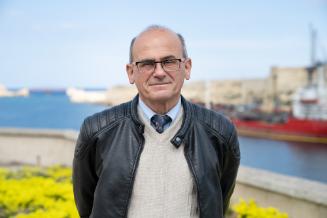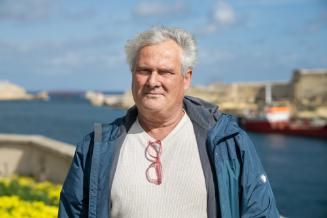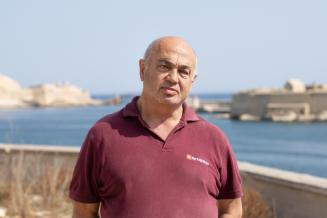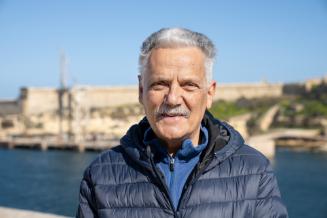
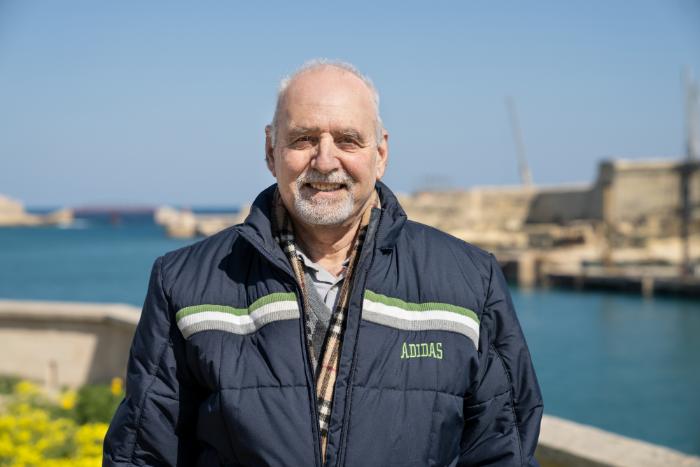
Oral history of the Malta Dockyard: Walter Vella
Interviewee
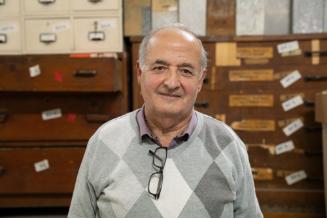
Walter Vella
Maltese, born 1949
Interviewed by
Joe Meli
Maltese, born 1953
Date22 September 2021
Classification(s)
Object TypeOral history
LanguageMaltese
Extent1 digital audio recording (WAV)
Registration NumberMMM.AV0074
DescriptionThis recorded interview was made as part of the Malta Dockyard Oral History project by the Digitisation Unit, Heritage Malta, under the direction of Joe Meli. Following an apprenticeship starting in 1966 and higher education thereafter, Walter Vella worked as mechanical fitter but was soon promoted as a Shiprepair Manager involved in various projects up till his resignation due to yard closure in 2008.Transcript / Summary
(This summary is a work in progress. Timings are approximate.)
Special Collection(00:30) He went to St. Joseph Technical School in Kordin, where he decided to take the dockyard exam. When he got chosen as an apprentice, he followed the mechanical fitter apprentice. During the first year of apprenticeship, they attended a General Course at the Technical Institute. In the 2nd year then, they were transferred to MCAST in Msida to attend the OTD (Ordinary Technician Diploma) course for 2 years. Then they followed the HTD (Higher Technician Diploma) for another 2 years.
(03:00) After getting the diplomas and certificates, they went to work as fitters-some in the machine shop and his case with the afloat section.
(03:45) He mentions how they were a gang (guy) made up of 12/15 people and when there was no work for everybody, then those with no work used to be charged with a code ‘99’ and stay in box-rack. He adds, that he was once on 99 code, while his colleagues were working on a vessel, named Felto and instead of staying in the box-rack, he went on this vessel to observe the work as he was very keen on learning, which did not go unnoticed by his chargeman. Eventually he was given work of certain level, such as working on diesel generators, which was more interesting and work, in comparison to working on, for example, sea valves.
(06:00) After five years of being a journeyman, he applied for the position of a management trainee. In his interview, he remembers Spiru Aquilina, Lorry Farrugia and the personnel manager Stanley Clews. He was chosen for the position and he started out being mentored by the senior shiprepair manager, Alfred Cachia.
The chosen trainees were a group of four and were under the charge of Manuel Formosa. They were shown around the dockyard, giving the more details on the docks, showing them things that were not obvious on a first-hand basis.
Afterwards, they were each assigned to a shiprepair manager and as trainees, they accompanied him as he went along with the work. The senior shiprepair manager, believed that one had to practice in order to learn, so after three to six months started giving him vessels to do on his own, backing him up if needed, but they had to work on their own.
(10:00) One of the projects he remembers was the ‘Simpson’, an ocean-going tug boat, which was converted into a modern and luxurious yacht. This project took about six months as they had to dismantle it, reconstruct and modify it, from top to bottom.
Foreign workers were also involved in the internal design and furniture. Facilities such as a pool, hoisting and storing of a seaplane, and so on.
At the time, this was a new concept for a yacht, and renowned clients were looking to buy such boats. This was due to the structure of such boats being able to handle extreme weather conditions, in comparison to other yachts. He remembers the superintendent Mr Kush, who was very tough to deal with.
(15:00) He remembers the vessel Mantinia, where they discovered bottom damage below the engine room, which was a complicated job, due to oil and fuel tanks situated there. There was also distortion in the alignment of the main engine in relation to the tail shaft. This meant that this type of work cannot be done without detailed planning. In this case, the damage was not something they were anticipating, as it was not recorded in the ship’s logbook.
(17:00) Among a lot of other vessels, he remembers a Seismic survey vessel, in No.5 dock, called the Western Monarch, this was one of the projects they did before the closure of the dockyard.
(17:30) Going back to the vessel Mantinia, its company was American Greek-Globe Shipping. The superintendent was Mr Koskinas. He had his assistants who were very efficient in their work.
Education-Projects
(19:15) He managed to build a good reputation with these foreign clients by working within the deadline, seeing to their requirements like setting up meetings with the superiors-up to a point where whenever these clients would send another vessel, they would ask for him and his team specifically to take care of their vessel. The personal relationship was excellent. All because they knew that Walter was going to do his utmost to finish the project successfully.
(23:00) The majority of the people he had met were generally friendly, however you can also meet difficult superintendents. He recalls this one time when the vessel superintendent had asked him to rent the equipment to use for certain works on the vessel. Mr. Vella did not accept, telling him that this was a shipyard and the work is to be done by the shipyard workers, and the yard equipment was not for rent. The superintendent started shouting at him, he even told him to leave the vessel. Mr. Vella only told the client the shipyard procedure, since, as the vessel is docked, they would ask the person in charge of the vessel if there are any works that are going to be done by the vessel crew, in order to be approved by the departments in charge before giving them the go ahead.
(27:30) In the latter years the ship crews changed to different nationalities which created language problems. This was a barrier between the crew members themselves as well as with the dockyard personnel. Especially when it came to work such as engine work, where the communication needs to be clear between the yard and the crew, as this could result in fatal accidents. Safety for the shipyard had number one priority.
Safety-Accidents
(30:45) Accident-Once he was on a night shift, he went to see the work on a vessel, where the shipwrights were fitting a doubler on the shipside and was being finished (isaffhuwa) for an insert. The workers confirmed that they had a fire watcher on board.
While he was checking on other jobs, the shipwrights started calling him as the tank had caught fire, even though the fire watcher was using a hose to put out the fire. They later found that the ship had some inflammable liquid onboard that caught fire.
He advised the crew and called the fire department but, in the meantime, found out that certain parts of the vessel were more dangerous due to the adjacent fuel tanks, so he advised the fire department to dampen these fuel tanks bulkheads for prevention propagation, In the end, the fire was put out.
Safety-Accidents
(34:30) Accident on a Koskinas’ vessel. He used to bring vessels often. A worker who was blasting in the tank, due to the pressure of grit and air, the hogger hit his leg with a lot of force injuring his thigh to the extent that his bone was exposed. They called for emergency medical attention and unfortunately, they had to cut off his leg.
Looking back-Skills gained
(37:00) He never looked for work elsewhere because in the dockyard there was always a place for them due to the fact that a vessel needed the majority of the trades and one can always learn new skills.
(40:30) They used to have production meetings every day, inviting different people at certain points in time so as to not leave the work unattended.
The ship manager of the vessel had to be updated daily, and these meetings were frequent. He always insisted to stay in contact with the work, looking and inspecting the work so as to always have the updated information.
There were superintendents with different characters. Some were not very technical.
(45:30) Walter mentions the OBO (Ore Bulk Oil) Zenith at Boiler Wharf. The ship had a large duct keel for the cargo lines. The ship was in the finishing stages of the repairs. They had to re-fit the access and when they started welding, the duct keel caught on fire, and it was very dangerous as the cargo lines were made of fibreglass. The crew managed to operate the foam system and use also fire hydrants to put out the fire.
(50:00) Another accident he recalls happened when someone was removing the vessel’s name from the side, situated on the forecastle deck and when he went to check what was inside the forecastle, and realised that the paint caught on fire, which fortunately was put out immediately. This accident could have resulted in a bigger fire because of the tanks of grease and ropes, and paint stored inside the compartment.
(51:45) The way he used to work, might have been different from the way others used to work but his main thing was to be there for his workers and supervise the work. It was important to be present.
Safety-Health and Safety procedures
(55:15) Safety awareness increased considerably by time. There was also the introduction of job cards, for safety reasons, this give details of every job that was to be done on the vessel and given to the vessel’s crew so everyone would know what everyone is working on.
Safety-Health and Safety procedures
(56:30) This involved a high amount of paperwork. He remembers the USS La Salle that was repaired in the shipyard. Walter used to panic when after 15 days, there was no work started due to the preparation of the paperwork, that had to be done for safety reasons and avoiding accidents when doing something that interferes with someone else work that might be fatal.
Malta Dockyard Oral History project
Dimensions1 hour 01 minutes 11 secondsProvenanceRecorded by Digitisation Unit, Heritage Malta.Online Collections
Public Access
Not on viewMuseumMalta Maritime Museum
Location
- Malta Maritime Museum, Reserve Collection