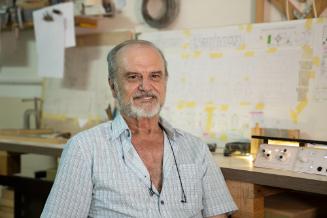
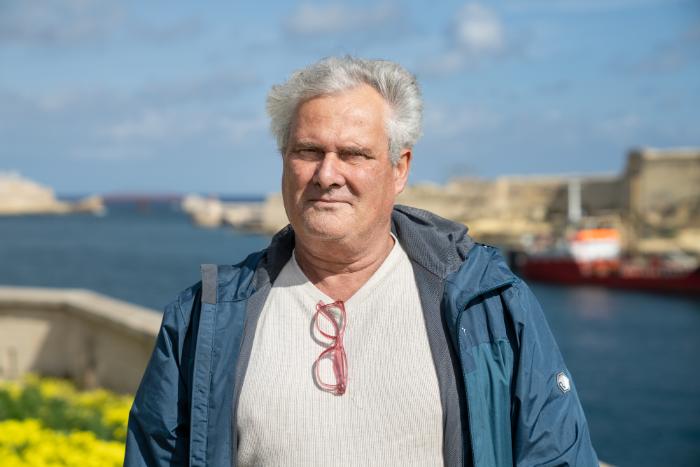
Oral history of the Malta Dockyard: Tony Vella
Interviewee
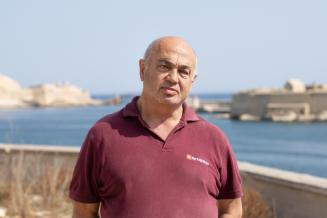
Tony Vella
Maltese, born 1958
Interviewed by
Joe Meli
Maltese, born 1953
Date15 July 2021
Classification(s)
Object TypeOral history
LanguageMaltese
Extent1 digital audio recording (WAV)
Registration NumberMMM.AV0062
DescriptionThis recorded interview was made as part of the Malta Dockyard Oral History project by the Digitisation Unit, Heritage Malta, under the direction of Joe Meli. Anthony Vella entered the yard in 1976 as an assistant tradesman and then allocated to the Smithery. He learned the Smithery trade both at the Smith Shop as well as working on board ship undergoing repairs. He left the yard, as foreman of smiths, in 2009 during the closing-down process.Transcript / Summary
(This summary is a work in progress. Timings are approximate.)
Special Collection(00:45) He started his journey in the Dockyard as an assistant tradesman, and joined as a sheet metal worker. During his training he was sent to the boilershop. Then after a few days, Anthony Vella together with Michael Incorvaja, were chosen to go to the smithery. During his first months, he was taken to the smithery in order to familiarise himself with the Dockyard. He states that he did not want to end up in this workshop, because the walls were black, there were forges (forog) and all workers were covered with soot. However, he was sent to that section.
(04:00) At first, he was not given work but he had only to assist the tradesman and get a feeling of the work being done. So, he was either helping the tradesman, or to transport the material from the store, etc. He states that during that time there were around 80 people working on the forges (forog). There was also an afloat section, but usually beginners were not sent to perform that work afloat.
(05:00) The smithery was the first shop that was built in the Dockyard, and moreover it was in the centre of the yard near the Melita Slip. Then he started to learn the Blacksmith trade. This included work such as stanchions made out of a solid round bar. They used to do brackets, saddles, tools for the masons, etc. One job he found interesting was the heavy forging using a large steam hammer. They used to do forgings for gear wheels, this meant shaping them and then sent to the machine shop for the final machine finishing. They used to do coupling bolts which required special material. These bolts were used for tail shaft and other machinery requirements.
(08:30) Then he started working with the afloat section. The section had about 80 people, two charge man, and foreman. Their main work was on the ship cranes. It was hard work and dangerous. Work on rope blocks, sheaves, derricks, crane wiring and other similar work.
(10:45) The items were grouped in sections, and everything was named, marked and stamped. He said that one has to keep in mind that they did not have technology like laptops or mobiles to take photo, so it was quite a complicated process.
(12:30) They used to do survey on the dock (Bacir) floor on the ship’s chain. This mainly consisting of the chain calibration. After taking the measurements of each length (section of 27.5 m) of chain, they calculate the average thickness. The allowance for wear was 12%. If this is exceeded, then something had to be done. It either had to be transposed, meaning the outer will be exchanged with the internal, or will have to be replaced, etc.
Working on the chain, especially when heating was involved, required special procedure of slow cooling down, etc. This meant that the work was usually a slow process.
(14:30) When there was the necessity to go in the chain locker, they had to use a Jacob’s ladder, which he describes as difficult to use it. Some used to agree instantly to use the ladder while others refused to use it. Tony Vella mentions that they had to coordinate work with one another. He recalls a very scary episode where an accident occurred. This was in No.6 dock, where a workman went down and the tank was already painted, and unluckily he could not breathe and it was very difficult for them to pull him up. But thankfully, he slowly began to regain consciousness and they managed to get him out of the chain locker. The work on board the ship requires support between all workers even from different trades.
(18:00) Tony Vella argues that by 1995, 1996 the work at the Dockyard was still at its best. However, then was an influx of workers from other places, and he states that they were not so disciplined. In fact, even the respect towards the chargeman declined. Not all of these new recruits were bad. A lot of them integrated in the system well.
(19:15) Things were changing slowly. Discipline towards safety was given more importance at late 1990s. In fact, the foreman and the chargeman had to supervise that every worker was wearing personal protective equipment, including hard hat, glasses, etc.
He remembers an accident, where a fitter was using a chain block, it was during a night shift and the chain block failed, and the load came on his feet and unfortunately, he ended without a leg. An investigation took place and after it was done Vella went to remove it, and it resulted that the victim was hurt because another chain block was put in place and it was defective. He states that they spent up to 9 years going to court.
(24:15) For the forging of metal process to make a stanchion, they used to heat the metal block white hot (more than red hot), you put the material under the steam hammer and a swage on top of the metal block. Then with the steam hammer start hammering in order to form the spheres of the stanchions.
(25:45) He states that he did several tools there, including nail pincers (tnalja). Once he went to Ireland, and while he was walking, he met with a Blacksmith. He saw him working and impressed himself how he kept the conservative way in working.
(27:45) Vella mentions the work of the hammer operator (mazzir). In the morning the hammer man (mazzir) opens the forge and cleans out the clinker (gagazza). He then puts wood in the forge, then puts some kerosene to fuel it and give it air to start the fire and heat the forge. Next break the coal and put the coal in and put bricks around it, then use a tool in the shape of a dagger (sejf) to shape it and then built the coal according to work that will be produced, example fabrication of staples. The staples, were fabricated in thousands and were used to fix the dock blocks together. They also did staples for the shipwrights which were like clamps (furficetta) to fix the template (galvu) of the steel plate (pjanca). They also used to do what they called obo lugs, it was a joggled flat bar, which welded in the ship’s hold and were used to take a sort of small A frame to fix staging when required.
(31:15) Once he remembers when a flat bar broke and as a result the staging collapsed and one worker fell off the staging and remained paralysed. From then onwards these lugs were tested for any cracks.
(32:15) He also states that they did heat treatment, mainly on springs, and other materials like copper as well as on forged items such as gearwheels. They had a big furnace with all the information on temperature and timings depending on the material or product. They did not have specialised people for this work, they did it themselves. In fact, Vella mentions, Peppi Delceppo, who was a spring specialist. They also had to do tempering (tempra)-they used to work through experience by looking at the changing of the metal colour as it was being heated. The process involved that if they required to temper (jittempraw) a spring, the colour would be bunsen-blue and then they would quench in oil. Then they would test the spring, by putting it in a pipe (for safety), and put pressure on it. They also used to do spring rings to fix tags on dogs (example police dogs)
(35:15) They also did work on ferro battuto. For example, the lamps for the knight’s halls at the Mediterranean Conference Hall. Also did the lamps that are in Valletta, these were done between them and the foundry (Funderija).
Safety-Accidents
(36:00) Vella was asked to speak about any accident that he remembers, and one that was still imprinted in mind was that of the buoy in No.1 dock. They used to go and transport material with a cart, and on that day, they were at the No.1 dock.
And all of a sudden, the buoy caught fire, and he describes that panic arose and unfortunately two people lost their life. He states that there was a leakage, from a burner, and when welding restarted the gas exploded and the buoy went on fire.
Another bad accident that he recalls was that of when a workman was caught by the drilling machine (trapan) in the fabrication shop.
Another accident episode was that of the Dock arm that collapsed in No.6 dock.
Then he remembers a young man aged between 18 and 19 from Kalkara, who died in No.5 Dock when he fell in the chain locker and died on the spot.
He also mentions the accident of Um El Faroud. Vella states that luckily his men were not working on it during the night, when the accident happened, because they had refused to work during the night. He remembers one of the dead that used to work with him, but had opted to change his work because he wanted to have some better income, and was caught and died in the accident.
He also mentions that a worker lost some fingers with the steam hammer.
Also, talks about Mansueto, he states that they use to hold the work with a big tongs (tnalja) and the steam hammer touched the tong (tnalja) and it penetrated his thigh. However, Vella describes him as lucky because it did not touch his bone.
Safety-Accidents
(44:00) Vella states that one of the dangers they had while doing heavy forging was that since the steam hammer was converted to work with air, water was forming in the system. The water was leaking on the red-hot material being forged, which turned immediately into steam which was very dangerous to the workers. He liked the heavy forging work, because generally it was very interesting and varied.
Safety-Accidents
(47:30) Moreover, he mentions that once he was working in No.5 dock, and was pulling out some crane wires, and there was a crane driver assisting him, known as ‘Lewzu’. After the break when they returned to continue the work, he was calling the crane who was not responding. After 30 minutes he got worried as the crane was open but he was not responding, and Vella phoned the crane driver’s chargeman, and they found him hanged as he was passing through a depression.
Safety-Accidents
(48:30) Another accident he recalls was in No.1 dock. During work to remove the jib from a crane where the counterweight was secured with wire. However, when they removed the crane jib, and went on the crane the counterweight gave way by itself, and it injured a person who was left in a wheelchair.
(50:00) When he finished from the dockyard he then went to Libya, working with Pantalesco. He had already spent 2 years going to Pantalesco learning their type of work. He finished from the shipyard in June 2009, and was offered a new contract with Pantalesco and he accepted to continue working with them. At first, he was not used to it, especially every night when their religion called for prayers. He states that it was not easy however when he eventually got used to the working in Libya, it was time for him to get back to Malta, because of the war in Libya. He spent 2 years working there, then did another year working in Malta. He then stopped as he was used to working in Tripoli and the salary there was much better than in Malta. Vella also mentioned that at the time Gaddafi was killed he was working on an oil rig working with Pantalesco, who had a contract for three maintenance services on oil rigs and he spent four months working on them. The contract was again extended for another 2 years, but after the 2 years, there were a lot of problems in Libya. He mentions that they could hear bombing ever morning. And once at 6 am they started to shoot at them and that was the end of Vella working at Libya. The trip back to Malta was not easy, as the airport was closed and they had to go to Tunes, Gerba.
(56:15) He states that he would redo his career at the dockyard. When he started, he had 11 Malta Liri in a week. He raised a family from there and he physically build his house. At the shipyard one could find a lot of support and assistance from colleagues.
Malta Dockyard Oral History project
Dimensions58 minutes 07 secondsProvenanceRecorded by Digitisation Unit, Heritage Malta.Online Collections
Public Access
Not on viewMuseumMalta Maritime Museum
Location
- Malta Maritime Museum, Reserve Collection