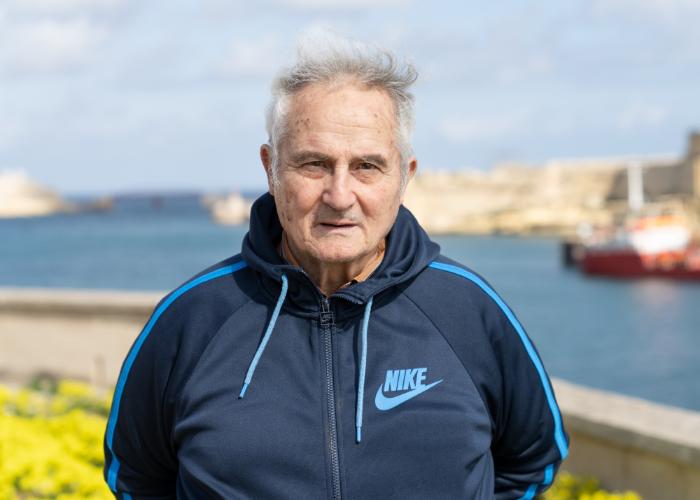
Oral history of the Malta Dockyard: Ronnie Armeni
Interviewee
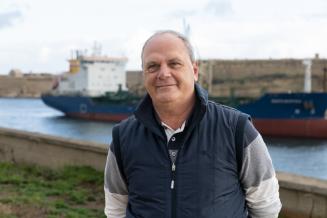
Aaron "Ronnie" Armeni
Interviewed by
Joe Meli
Maltese, born 1953
Date26 May 2021
Classification(s)
Object TypeOral history
LanguageMaltese
Extent1 digital audio recording (WAV)
Registration NumberMMM.AV0043
DescriptionThis recorded interview was made as part of the Malta Dockyard Oral History project by the Digitisation Unit, Heritage Malta, under the direction of Joe Meli. Ronnie joined the Dockyard in 1955 as an electrical fitter apprentice. He completed his apprenticeship when Bailey was managing the dockyard and at that time diversification work was being introduced such as electrical installations for new factories. Then around 1981 he moved as an estimator with the shiprepair section. He progressed his career up to Estimating Manager, from where he retired in 2002.Transcript / Summary
(This summary is a work in progress. Timings are approximate.)
Special CollectionEducation-Apprenticeship process
(0:30) According to Armeni, one had to be around 14 and 16 years old to be able to sit for the Dockyard exam. The first time he showed interest to join he was still young and therefore attended Class Dockyard F, and a year later he was in Class Dockyard A. The exam was at De La Salle and there was an average of about 1,600 students. After he received his result, he had an interview at the Dockyard technical school. He had the opportunity to choose his trade, and chose electrical fitter and continued as an electrician.
Education-Apprenticeship process
(02:30) On 5th October, 1955, he started his first day at the Dockyard and went to sign the Indenture, which was the contract that one had to sign in order to work at the Dockyard. The apprentice training was at No.1 Dock. He spent one year there learning how to use tools and various trades. His second year was in the main electrical shop, he spent his first three months with the motor-winding section and then doing bench fitting work. During his third year he was with the afloat section.
(04:00) With the afloat section he was with a group of apprentices and instructors doing the electrical wiring of the Kordin Stores. Once his friend Joe Blackman injured himself as a plank fell on him and he broke his leg.
Entering the dockyard-Dockyard layout
(04:15) He enjoyed working with teleprinters, as he used to go to Hal Far and to the Turetta (Valletta Port Control). The teleprinter was a way of sending messages. He states that the teleprinter office was near No.2 and No.3 docks.
(06:00) He remembers 28th April 1958, when at that time he was working with the yard machinery. The work station was in dockyard creek below the Sheer Bastion. His instructor told him to stay in the room and stay there. Being young he could not resist to see what was going on, and he remembers that on going out, he saw the workers running after the Admiral. This was near the Sheer Bastion.
(07:00) On his final year, he was sent with the afloat section with Mr Deguara. He remembers when in 1976 the Chinese came to build factories and one of which was the factory for manufacture of glass. They had a machine which they were working on, but they were finding it difficult to do so. But somehow Armeni discussed this with the Chinese engineer and managed to fix it.
(10:15) He recalls that when he was in his second year, they used to swim in the sea. He mentions that once a man known as the ‘Ginger’ fell into the sea and they managed to save him.
(11:00) When he was a fitter, he worked on general refurbishment on Naval ships. Once he was working at the ‘Spinning and Weaving’ factory and he was working with the cable and unfortunately, due to pulling too much he got a slip disk and ended 10 months at home. After that he was sent to Manoel Island and was given the job of a clerk. This was around the year 1976.
(13:30) Then around 1981 he applied for the post for an estimator with the shiprepair section and was chosen. From 1981 up to 2002 he moved from leading estimator to Deputy Estimating manager and finally to Estimating Manager.
Entering the dockyard-Trades (From approval to the departure of a vessel)
(14:30) The work of the estimator was to assess the work required the ship by the ship owner, and assess shipyard cost to do the work namely man-hours and material required. The work specification is distributed to different estimators depending on the type of work required, and once completed all estimates are gathered and checked by the supervisors and adjusted as required. This is then passed to the Commercial manager who decides the level of the pricing to be quoted to the ship owner. The job of an estimator was highly technical in their respective trades.
(17:45) Armeni remembers various estimators, he mentions Tony De Gray who was on the engineering section, Victor Camilleri who worked on the hull section. He also mentions Charles Mizzi who worked also on the hull section, and others. The electrical side of the tender was relatively minor, so a lot of time he was asked to write up the estimate in telex form so that it could be sent to the owners. He took this as an opportunity to learn and absorb the way the other sections worked, where he did not experience work.
(23:00) One thing that he remembers was when he was asked to give an estimate to make the cleaning and varnishing of a main generator, and he did it well. His father’s trade was that of a carpenter, and worked with the ‘British Service’ doing doors, windows, etc. He states that he always wanted to learn new thing and do things the right way. In fact, he emphasises that he learned a lot from the Dockyard.
Looking back-Reflections
(31:45) Ronnie mentions that the dockyard was known as the university of work and it is true that there were some workers who were a burden to other workers who were excellent and hard working. Ronnie always looked at latter type of people to learn what he can.
(25:30) He looks back to his experience very positively. He raised his family and from there you learn everything. His only remorse is that nowadays the Dockyard is no longer the same, and states that for today’s work they use foreigners instead of Maltese.
Malta Dockyard Oral History project
Dimensions32 minutes 07 secondsProvenanceRecorded by Digitisation Unit, Heritage Malta.Online Collections
Public Access
Not on viewMuseumMalta Maritime Museum
Location
- Malta Maritime Museum, Reserve Collection