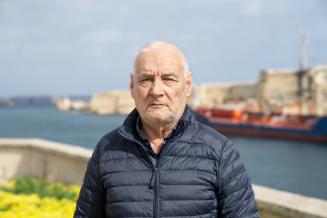
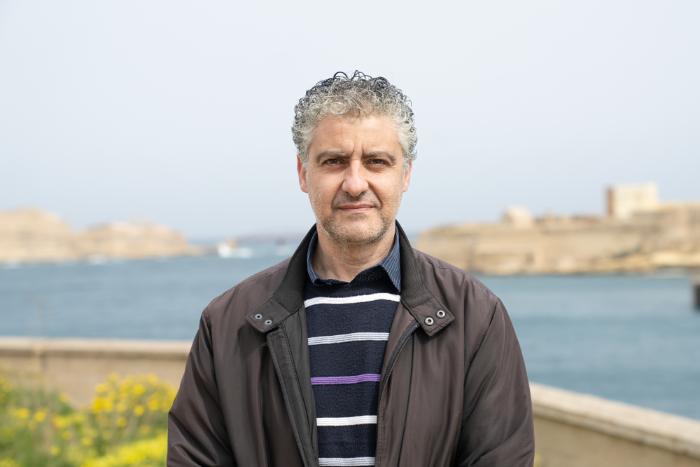
Oral history of the Malta Dockyard: Charlot Carabott
Interviewee
Charlot Carabott
Maltese, born 1971
Interviewed by
Joe Meli
Maltese, born 1953
Date7 October 2021
Classification(s)
Object TypeOral history
LanguageMaltese
Extent1 digital audio recording (WAV)
Registration NumberMMM.AV0079
DescriptionThis recorded interview was made as part of the Malta Dockyard Oral History project by the Digitisation Unit, Heritage Malta, under the direction of Joe Meli. Charlot Carabott entered the yard when he was a 15-year-old in 1987 and following work experience and higher education studies, he worked as an electrical fitter before transferring to the Electronics department and the Drawing office (electrical). He was promoted as a ship manager but eventually took over the managing of the Electrical operations at the yard until the yard closed down in 2010.Transcript / Summary
(This summary is a work in progress. Timings are approximate.)
Special Collection(00:30) Even though it was very normal for a 15-year-old to enter the dockyard in the ’50s and in his time since they had stopped enrolling apprentices for around six years, it looked strange, especially since in 1987 school was obligatory till 16 years of age.
(01:45) He had finished his O-levels in his fourth year in the secondary school and when the dockyard announced that they were enrolling apprentices, his father spoke with the school to give him special permission to leave school earlier.
(02:30) He satb for the intelligence test and was chosen as an apprentice. He then stopped attending his 5th year at the secondary school. It was a bit risky at his age to do such, especially considering that he wanted to continue studying but with his father’s encouragement, he took the risk.
Entering the dockyard-Reasons for joining
(03:15) He lived in Bormla, a street near the dockyard, so the dockyard was a part of his everyday life-especially when he was a very young boy, playing on the streets at the time people from the dockyard finished their shift and they had to stop playing and get inside due to the amount of commotion of cars, bikes, and buses-but for him, it was a fascinating scene to see. He went on mentioning, how when they were young, they used to throw the ball inside the dockyard, as an excuse to get permission inside to see what is inside-only till the plate shop and smithery-up to where a ball can possibly go.
Entering the dockyard-Reasons for joining
(05:30) His grandfather worked in the dockyard as well, he was out-station so he was not every day in the dockyard, he mentioned places like Rinella and Ricasoli. His grandfather died when his father was still at a young age, he worked there as well and was discharged in the time of the Admiralty.
Entering the dockyard-Reasons for joining
(06:15) He did not have grandfathers growing up but they had this neighbour (Guzeppi Gatt-Shipwright), who he sees as a grandfather figure, who used to teach him a lot about various manual work. Furthermore, due to his father, who was a carpenter and his neighbour’s teachings, he had a very clear idea of various manual works carried out in the dockyard. This was a reason why Charlot could not resist the to take the opportunity to work at the dockyard. Mr Guzeppi Gatt, during Christmas Eve, when the workers could take their children to the dockyard, used to take him and teach him about ships and docks and that was why he was more exposed to what the dockyard offered.
(08:15) When he started his apprenticeship, the majority chose to work at the shipbuilding, while he and 81 others chose the dockyard. The system to choose the trade was based on the examination order of merit. His good placement gave him the right to choose the trade, and he chose the electrical trade, working in the radio shop.
This method of choosing the trade, created some conflict between the new apprentices, as there were some who came from the Technical Institute and who had already completed Mechanical technician courses and who had to choose other trades such as welder burners, due to their placing in the Apprentices’ entrance examination.
(10:15) Since he did not finish school or had any extra qualifications, like most of the other apprentices, he had to learn everything in the dockyard, starting from lathe work, sheet metal, steelwork, bench fitting, electrical, pipework, and welding-from February to September. He took his first year very seriously.
(11:45) He spoke with Victor Debono-head of the radio shop department-to guide him better on what he should study to fulfil his duties well as an electronics fitter, and was advised to study the radio and TV electronics course. After he applied for the course, he was called by Mr De Gray, telling him that with all the qualifications he has, it was ideal for him to do an OTD-Ordinary Technical Diploma instead. At first, he was a bit hesitant due to the fact that he felt as though he was going against Mr Debono’s advice but after considering it further, he went ahead with it.
(16:00) He got the diploma at 19 years of age while he was still an apprentice. He chose Electronics as a special subject.
For people over the age of 18, their wage was that of the minimum wage, while others were given that of 25 Malta Lira per week.
Entering the dockyard-Trades (From approval to the departure of a vessel)
(17:15) During his apprenticeship, he was allocated to an instructor. In the radio shop, there were 2 sections, one for engine room work, and another for bridge work. The engine room work was on boiler controls, repairs in the control room or on machinery and Graviner oil mist detector. On the other hand, the bridge/wheelhouse work was on radars, gyro compasses, radio stations, public address systems, and any general electrical works on the ships. He worked with both departments, since he was very interested in the trade especially when it came to engines/machines. In fact, he was doing work related to the oil mist detectors on his own. He also liked working on high ground like radars.
(20:15) In 1991, he became a fitter but still wanted to get more qualifications such as going to the sixth form to do his A levels and become an engineer. However, the dockyard did not sponsor courses apart from Diploma courses like OTD & HTD.
Eventually, after completing the HTD, they were then offered the chance to go to the sixth form to complete one necessary A Level, which many were interested in and went ahead but he decided to continue working normally in the dockyard and get the physics A Level on his own. Then again, even though he had the right qualifications to become an engineer, he stayed working in the radio shop, as a fitter, for three years.
(23:15) In 1993, he got called by his manager, Mr Lawrence Zammit, that there was an opportunity for him to study in Germany on gyro compasses. After further consideration about what the future holds for him, he was sent to Hamburg, Germany with a company called C Platt to study on Gyro Compasses.
(24:45) After a year, there was a vacancy for an Electrical Draughtsman in the Drawing office (DOL-The ‘L’ is for Electrical) and after he passed the examination, he became an Electrical Draughtsman. He also added, that even though his co-workers were in their 50s and he was in his 20s, he did not feel that age gap at all, and he fitted without any problems and still to this day he respects them and still in contact with them.
(28:00) The drawing office was split into two groups who worked on the Dockyard Plant equipment and a group who worked onboard ships. In his case, he was flexible and worked in both places, which helped him understand the infrastructure of the shipyard, as well as other experience.
(29:30) They were involved in converting the overhead travelling cranes in the workshops to have a remote control instead of a crane driver. This meant that crane drivers were redundant and they had some resistance to this change.
He mentions another example of the TEL (Temporary Electric Lighting), which at that time the system was using fuses and electrical supply and was highly dangerous. Ivan Bonello, decided to make these boxes with breakers, with proper socket outlet, to plug the temporary leads. There was some resistance to change as the workers thought that this would reduce their overtime, however the project still went ahead by involving the workers in the process to get used to it more. In fact, he mentioned that he still had the initial sketches showing these boxes.
(32:00) He goes back to the overhead travellers-they had to get to study in detail the crane’s working system, where there was what was called the Deadman’s handle (levers controlled from the cabin and the driver controls the speed-they had three actions: Long Travel-crane moves along the workshop, Cross Travel-where the crab moves across the workshop, Hoisting action-where the hook moves up and down), they would each be installed with contactors, installing a ‘pedant’ control on the ground which moves with the traveller. Mr Pule, who was the leading draughtsman, showed him how to do the first one.
The speed control had to be left in its place, except for the long travel function since now the operator had to walk with the traveller, so the system had to eliminate the last speed setting. The final product for this project was a manual with various instructions, diagrams and parts needed for the new system to be manufactured and installed, as well as new operation instructions.
(35:30) In 1996, there was an opening for a position as a shiprepair manager trainee, for which he applied even though he did not conform with the minimum age requirements which was about 30. He still went ahead with the application and sat for an interview. Since he was a draughtsman, people had told him that it would be a bit of a disadvantage since they were seen as more theoretical people rather than practical.
During the interview, as the last comment, he told the interviewers to judge him by his skills and not because he was a draughtsman. He was chosen for the position.
(39:45) Along the way, while he was getting the necessary training to become a shiprepair manager, Mr. Abdilla who was the Divisional Engineering manager-whom he knew from the time he was working with the engineering department, approached him.
Mr. Abdilla asked Charlot if he would be willing to take the place of Lewis Spiteri, who was the head of the electrical department who was retiring. Abdilla told him that he had the necessary qualifications, and if he accepted, he would continue his training with the department to take over the position.
(43:00) As the Electrical Departmental manager, he had to manage two sections: the electrical shop and the electrical afloat section.
In the electrical shop, the foreman was Charles Attard, and afloat there were Leli Farrugia (ir-romblu) and Joe Grima. There were about 100 men in the department.
He tried to take the attitude of respect especially to the foremen, and considering Charlot’s young age he managed to work well.
The technical issues in the department were not easy, but they always found a solution. The human part and relations with the union was a bit more difficult. He took his managerial position when the Malta Shipbuilding took the contract for the building of three ferries, and it was decided that a gang of electricians had to work on these ships at the Marsa site. Obviously, they had a lot of resistance from the workers who were chosen to go to Marsa.
The department had a number of electricians that were transferred from Malta Shipbuilding to the Malta Drydocks, and this created a bit of disparity. He had to make sure and explain that there was no difference between the workers coming from the shipbuilding and the drydocks people. Everyone was needed for an organization to work; everyone was needed for different work.
(57:30) He remembers the case when of one of his fitters was not accepted for a position of shiprepair accountant. The fitter blamed this on his manager, which was not correct, and took the attitude of working under a sort of protest, causing conflict within the department. Eventually they spoke and reasoned with him the situation, which he understood with time and changed his attitude.
(59:30) The electrical shop also carried out work for local companies/individuals. As an example of a generator, where its owner declared that there was no one in Malta that could solve his problem. These instances instigated pride in the workers who made their best to solve his problems and generally they did solve all problems they had. Charlot got concerned with the situations, because he was worried of the cost involved. By time the electrical department had to change certain processes due to reduction of personnel and reduction of work.
(1:05:30) The afloat section, apart from the traditional electrical works, they were responsible for the process called post weld heat treatment (stress relieving). This process is carried out after certain welding works are done on structures that had a lot of welding and thick materials. This was a continuous process that required meticulous work to monitor and record temperatures. Other work was removal of generators, cleaning of switchboards, wiring of various equipment and other work. Unfortunately, the electrical work was always last on the priority list, as it was rarely considered as a critical.
Education-Projects
(1:12:30) There was a lot of stress in terms of always having to be ready and anticipate what to come, and how they will manage everything within the given time frame. They had to give everything its priority since there would be a lot of projects that needed to be worked on, in the same periods of time. This meant that the workers even had to switch from one project to another, which required to keep track on the work in hand so as to have a continuous working operation. Also, the coordinating of works between the shops and afloat was very important.
(1:13:30) Due to reduction of personnel, the management was stressing the requirement for change in the work practices. Flexibility was one of the changes being pushed. This means that the afloat worker was also responsible to carry out himself any work required in the shop. This had its advantages because the same worker was taking the responsibility of the complete job. On the other hand, generally the workers at the shop were people who had some problems going on board. One other request was that the workers are pooled, and grouped for a particular job and then return back to the pool.
Safety-Health and Safety procedures
(1:19:15) Health & Safety - wearing the necessary safety equipment and how they led by example so that the workers would wear it even if they disagreed with health and safety procedures.
(1:20:15) Charlot concludes that his view of the dockyard is not just good because he worked there. He completed a master’s degree at the University and he remembers one of the lecturers who stressed the importance of planning the work. The lecturer gave an example on how when building the new parliament, they finished one of the ceilings and realised afterwards that they had forgotten to install a steel staircase structure.
In comparison, one realises the amount of planning and imaginative access work required in an engine room, tanks and other confined spaces in a ship.
The dismantling of parts of a ship to remove shafts, machinery, piping and other equipment was practically part of the everyday requirements from a shipyard worker.
Looking back-Skills gained
(1:23:30) Charlot states that in 12 years he has passed seeing and participating in construction projects outside the dockyard, he has never seen any project as those done at the shipyard. Up to now he has never seen any project involving high technical aspects, the cost in relation to the time, the different trades working at the same time and place, etc. as there were in the dockyard.
Malta Dockyard Oral History project
Dimensions1 hour 23 minutes 37 secondsProvenanceRecorded by Digitisation Unit, Heritage Malta.Online Collections
Public Access
Not on viewMuseumMalta Maritime Museum
Location
- Malta Maritime Museum, Reserve Collection