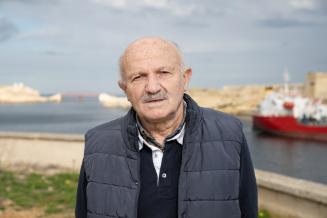
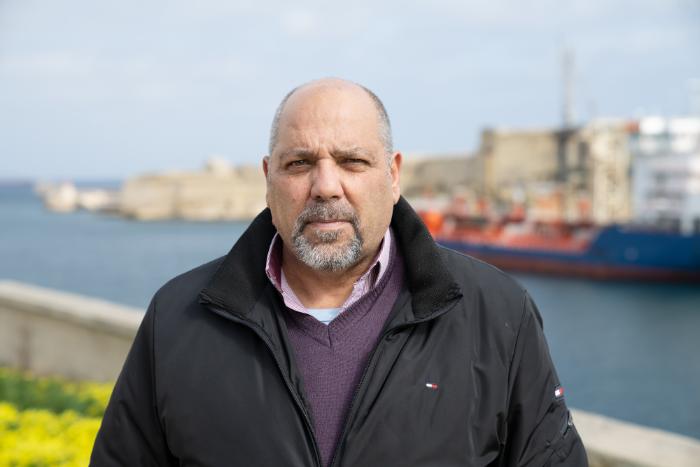
Oral history of the Malta Dockyard: Charlie Dingli
Interviewee
Charlie Dingli
Maltese, born 1962
Interviewed by
Aaron Edward Cole
Date28 July 2021
Classification(s)
Object TypeOral history
LanguageMaltese
Extent1 digital audio recording (WAV)
Registration NumberMMM.AV0065
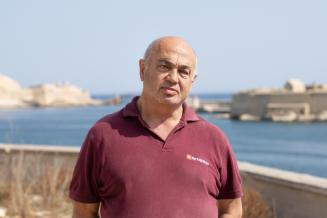
DescriptionThis recorded interview was made as part of the Malta Dockyard Oral History project by the Digitisation Unit, Heritage Malta, under the direction of Joe Meli. Charlie Dingli entered the yard in 1980 as an apprentice and following years working as a welder on various projects, he ended up teaching new recruits at the Training Centre until his resignation in 2008 during the process of closing-down.Transcript / Summary
(This summary is a work in progress. Timings are approximate.)
Special Collection(00:45) He joined as an apprentice with another 120 students. He answered to an application in the Government Gazette. He states that there were more than 1000 students sitting for the exam which took place at the Baviera in Valletta. The test was an I.Q test. At school, by trade he was a fitter, but by age 17, he left school and went to work instead. He worked full time first as a waiter and then with the minibus. Then at age 18 he joined the dockyard. He even states that during his apprenticeship period, he still worked part time with the minibus.
(02:45) He claims that the training centre of the Dockyard was one of the best. At later stages he even became an instructor there. He remembers people coming and giving out talks about the Dockyard, safety, etc.
(04:15) The apprenticeship in the first year included practical training at the training centre and attending school. They were not permitted to go around the yard, unless accompanied by an instructor. Then during the second year they were allocated to a workshop and attending also school, staying three days in the Dockyard and two days at school. He adds that during the second year they were not permitted to go onboard ships.
In the workshop they were attached to an instructor, who taught them the trade and other things that are not normally taught in school, like how to be on time for work.
He showed interest to go to the shipyard garage. He asked his training supervisor Mr. Meli, who told him that they have never sent apprentices to the garage. Dingli was the first apprentice that went to the garage.
Education-Interesting training and skills
He mentions that he learned to do other tasks, including car handles and car mascots. In other words, practically Dingli spent all his second year at the garage, which was the normal practice.
(10:15) During his third year they went to the office of the Manager who was at that time Sur Pawl, who assigned them to gangs, where each gang was managed by their chargeman. He was assigned with the chargeman Tarcisio Scicluna, who in turn assigned him to Lorry Camilleri as his instructor. Charlie was quite good in his trade and he started working alone in a short period of time. When he started working onboard, he remembers that there was a lot of work to be done.
Education-Employment pathways / local and foreign training opportunities
(16:00) He stayed until 1988 working onboard ships, because then the manager asked him if he is interested to teach the new apprentices. In 1989 he went to the welding school but was only attending on and off, eventually he became an instructor in 1996.
In 1989, one of the instructors was on long sick leave, and for him it was his first experience in teaching. They were four instructors, and made a teaching programme and in total there were about 100 welder apprentices. They decided to divide them in two groups of 50, and then divided them again between four instructors, meaning having 25 students each.
(21:15) The apprentices were tested as burners, which included how to do a clean cut with the cutter and how to separate the plates (pjanci) from each other without damaging them.
With reference to the welding tests, these included, welding in different positions that is vertical, overhead and flat welding.
(24:30) Another test that they used to have during the final trade test, was to remove (issaffi) the nut (skorfina) from its bolt without damaging the bolt and its thread (kamin). This was quite a difficult job to do.
(26:15) Talking again about when he was an instructor on and off, and in 1996 he became an instructor. Welding on certain jobs required the welder to be tested on particular welding procedures. They used to have a lot of established welders to do these tests.
Dingli pointed out to them that he did not actually want to teach these established welders, because they were already good welders, he only needed to guide them to follow a procedure in order to pass their tests.
(28:45) During the first years in the welding school, the welders to be tested were quite reluctant to follow the instructions of their instructors. But by time these welders got used to the system. He adds that it was a great experience, from which he even learned during the process.
(30:15) He remembers that then the training department required an instructor for pipe work, and he decided to offer to teach pipework. He was not a pipeworker but stated that he had some knowledge, because he had some basic knowledge of the trade.
The training centre covered various trades. The training centre of the dockyard was divided into several workshops and where 8 trades were taught: electrical installations, pipefitter, bench fitting, lathe work, sheet metal, blacksmith, and welding.
He mentions that the apprentices spent four weeks on each trade. At the training centre he began teaching pipework and plumbing, where they cut threads (kamini). By time there was an arrangement with the Government Education Department where students from the “Lorenzo Gafà” school started getting trade training at the yard training centre, where the best 25 students were selected. These were allocated to trades in line with the student’s preference. The students were difficult students; however, their attitude finally was good as they felt that they were not at school but in a workshop.
Safety-Accidents
(39:00) He remembers when the dock arm of No.6 dock collapsed. This accident happened due to erosion of the concrete (konkos). In fact, he states that those who were in the bucket fell about 5 storeys. Another accident he recalls is when one fell at the plate shop while they were changing the roof plating (pjanci tas-saqaf) and ended up on the workshop floor. He even remembers when one of his friends who was working continuous-time during the break, and was welding on the shipside and there was a water leakage and he was electrocuted. He also remembers another accident when a worker died when a heavy plate (pjanca) hit him. The guy was called Gianni tar-Rabat, and on that same day he was going for the wife, who had just given birth to a daughter. The accident happened when Gianni was at No.6 dock cutting a steel plate from the bottom of a ship, but after doing all the gas cutting, the plate did not fell off. To check what was holding the plate, he passed from underneath the plate and it suddenly fell on him and killed him.
Then he mentions the famous accident of the Um El Faroud. He was leave on that day but heard the news from the radio. He was so shocked and states that it was a huge blow for the yard. There were even certain workers who left the dockyard after the accident.
(46:00) He had a personal accident when he was once onboard. He was at the bottom of the forward peak of a Greek ship, where he was working at the bottom of the tank, when a pipe broke and caught fire. Charlie kicked the pipe until someone closed the gas cylinders (cilindru), but as soon as his friend handed it to him the pipe exploded, and he burned his hand.
Looking back-Memories of the Last Day
(50:00) Then the news spread that the Dockyard was about to close, and he was one of the first to receive the letter of 2008, that was the last group to work there. Dingli states that they were afraid that the Dockyard was about to close down because most of the workers including him, had spent all their lives there. In fact, he mentions that it was difficult for them to find another job, because whenever they call for a vacancy, and are asked where they used to work and they mention the dockyard, they would instantly be turned down. However, by time people realised that the Dockyard workers were all-rounders, and they were adequate in doing maintenance in hotels, etc.
(51:45) He then joined Lufthansa, because they had a lot of students and the company needed workers from the Dockyard to show them and pass on their experience. The knowledge and common sense were important attributes that the workers had. He worked there for four years. He claims that while he worked at the Dockyard, he used to teach evening classes on welding at MCAST, and when he finished from the Dockyard, he still continued teaching.
Safety-Health and Safety procedures
(57:00) He finished working at the Dockyard in 2008, so by that time safety regulations were introduced. However, he remembers that when he joined, they use to work with burners in shorts and flip-flop. At the end, conditions improved, and all workers had to follow the safety measures, like wearing safety equipment. The conditions of work were difficult and cannot be compared to anywhere else. In fact, one dangerous episode he remembers was, when they were assigned to do a job, but Dingli realised before they started working that there was a gas leak and the tank was not gas-free. Malta Dockyard Oral History project
Dimensions1 hour 01 minutes 26 secondsProvenanceRecorded by Digitisation Unit, Heritage Malta.Online Collections
Public Access
Not on viewMuseumMalta Maritime Museum
Location
- Malta Maritime Museum, Reserve Collection