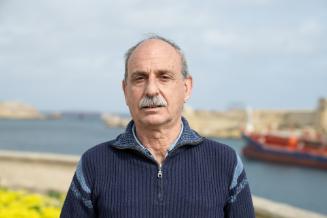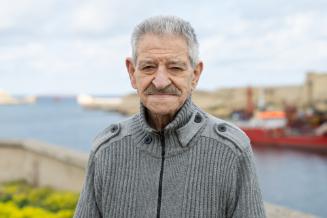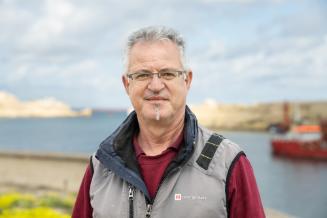


Oral history of the Malta Dockyard: Lewis Spiteri
Interviewee
Lewis Spiteri
Maltese, born 1943
Interviewed by
Joe Meli
Maltese, born 1953
Date19 October 2021
Classification(s)
Object TypeOral history
LanguageMaltese
Extent1 digital audio recording (WAV)
Registration NumberMMM.AV0084
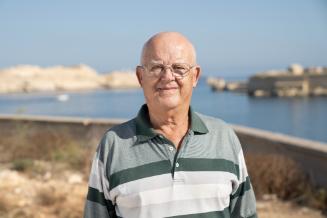
DescriptionThis recorded interview was made as part of the Malta Dockyard Oral History project by the Digitisation Unit, Heritage Malta, under the direction of Joe Meli. In 1958 Lewis Spiteri was one of the last Admiralty apprentices’ entry. He became a shipwright before shifting to the Training Centre as an instructor furthering his teaching studies abroad. During his yard-life Lewis was involved in the running of the Yard as an elected Council Member and retired from the Yard as the Personnel Manager.Transcript / Summary
(This summary is a work in progress. Timings are approximate.)
Special CollectionEducation-Apprenticeship process
(00:30) He entered the Dockyard on 3rd November 1958 as a shipwright apprentice on the last Admiralty entry. During that time, they used to refer to the dockyard as “HM Naval Yard”. He recalls the recruitment taking place from De La Salle or from St. Michael’s School with about 100-120 entries every year.
(01:15) The first step in his apprenticeship was a written exam, a paper about general knowledge, mathematics, and mechanics, nowadays known better as physics. Whoever passed these exams would proceed to an interview carried out by English officials. Afterwards, a medical test would be carried out which was a bit challenging. He recalls a friend not passing the medical test merely because of poor eyesight. He considers the apprenticeship as a tough procedure which lasted for six years and was divided between practice and theory.
(02:30) He recalls that during school, they would be tested every three months and whoever fails to pass would be stopped from attending further school lessons. Lewis managed to stay enrolled until the very end. In 1959 Bailey arrived and it decided to maintain the school for an additional year provided that the workers were to be considered as having the education of 6 years, as if they graduated with a diploma. Although they protested for such recognition to be done in writing, they failed to attain such goal.
(03:15) After the dockyard college closed, they were sent to the technical institute and they were divided according to their trade. His first mentor was Joe Abela who was a draughtsman on the hull. His second mentor was is-Sur Zerafa who was also a draughtsman and was followed by is-Sur Mizzi who was a Chief draughtsman.
Education-Apprenticeship process
(04:15) The apprenticeship was divided into three grades. These consisted of craftsman grade, technician grade, and student grade. The student grade gave the opportunity for apprentices to keep on advancing, for instance the chemists and the managerial grade. Whoever pursued the student grade generally had the opportunity to further their studies abroad in the UK.
(05:30) The apprenticeship system provided them with endless opportunities. The first year was spent dedicated to their craft. Lewis’s craft was that of a shipwright and thus he spent his first year working with metalwork and later on shifting to woodwork. This was considered as group training of about 25 apprentices. The rest of the years were spent as on the job training, starting first from working in the workshops and then moving to working afloat, which means on ships. This can be seen as a safety measure as they were introduced to the work environment gradually start from shop work which was less dangerous.
Safety-Health issues (noise, risks)
(06:15) He remarks the difference between a shipwright who works in a shop and a shipwright who works afloat. During his time in the personnel department, when a shipwright afloat used to injure himself working on the job, he would be compensated for a year’s salary. Afterwards, it was not possible to recruit him back as a shipwright afloat. Therefore, he would be sent to work as a shipwright in a shop. However, there were still some who preferred to be sent back afloat even after their injury.
(08:15) During his second year, he was sent to a shop where he got used to the system and learned how to read a drawing. He notes that those who used to work afloat were not as skilled in reading drawings. The difference is that at the shop they used to work in pairs following the available drawing. Meanwhile, shipwrights afloat used to work in groups whereby three or four would be leaders who guide the rest of the workers. For his third year, he was sent to work with his instructor on a one-to-one basis.
Entering the dockyard-Swan Hunter / Bailey / changeovers
(11:30) After he finished his sixth year, he was allocated with the shipwrights afloat. Swan Hunter arrived in 1963 and the company introduced the shift system whereby the workers worked on a 2-week shift system. Lewis found it very difficult for him to adapt as it was totally different to what he was used to. Consequently, he asked to be moved to the shop and there he was given the position of a ‘primalista’. He describes the ‘primalista’ as the second-in-charge of the chargeman.
Education-Employment pathways / local and foreign training opportunities
(15:30) After a while, Lewis realised that he was never going to get used to the shifts at the shop and started applying to every vacancy available at the dockyard. One of the vacancies was that of a training instructor to teach sheet metal and light plate work. Lewis notes that in the yard all vacancies gave priority to internal applications. If they could not get anybody from within the yard, then the management went out for external applications. In fact, all management, except the Financial Controller and the Doctor, came from within the shipyard. This was a good system as people had a good background of the shipyard
(17:45) In 1967, the apprenticeship programme had changed from when he had attended. A noteworthy difference is that the duration of the apprenticeship was lowered from six years to four years. During their first year, an apprentice would practice all the different trades. This was a better strategy as they would eventually need to work with their co-workers and learn different skills which may help them when they pursue the trade they want. A similar procedure is that during their second year, the apprentices are sent to work in a shop. Another difference is that the apprentices would be arriving from a trade school and thus they would have some prior knowledge on certain things, for instance how to use certain tools. When it comes to their third year, they would be sent out to work on a job with the instructor on a one-to-one basis. They introduced new schemes such as the best apprentice. After their four years, the apprentice would be given the ‘final trade test’ (it-test tal-paga) to get the journeyman certificate.
Education-Interesting training and skills
(20:45) As part of his training as an instructor, Lewis was sent abroad with the Commonwealth scheme where he was taught ‘teaching techniques’. From this scheme he learned tips which he still uses till this day. For instance, body language, how to plan an interesting lesson, 5 minutes demonstration, and so on.
(21:45) Lewis recalls that one major change during his time was the system of box racks. During his time the workers used to have a box where they kept their clothes, etc. They had to change their work clothes and store them in their box. He recalls the wooden box he used to take with him, which he now gave to his children. He used to open it every morning and change into his canvas overalls while storing his normal clothes in the wooden box, since they did not have any lockers. He mentions a system they used to use called the box-rack, where the boxes would be stored in racks next to the docks to be near their place of work.
(23:30) Lewis noticed this change when he went to the training centre to visit the apprentices and take a look at their changing rooms. They had new metal lockers and places to hang their clothes, they were given a heater and provided with the service of a canteen. However, the system remained the same including the craft, technician, and the student grades. As time went by, the only change they made was to the examination and this included change in the employment of a British examination officer, which eliminated any doubts on exam results, etc. Also, the focus of the examination shifted from that used by the Admiralty system to a more logical testing of the candidates. This consisted of sitting for an interview and then choosing the trade.
(26:15) As a training department, they advanced and entered into a traineeship scheme regarding management. This included the advantage of having contact with foreigners in order to adopt part of their schemes, not necessarily lock stock and barrel.
Education-Employment pathways / local and foreign training opportunities
(27:30) In 1971, the new Labour Government adopted a new system known as ‘workers participation’ whereby half of the directors were members from the Union and the other half were members from the government. In 1975, the Malta Drydock law was passed which allowed for the directors to be chosen by the dockyard workers themselves, whereby a chairman is chosen amongst themselves.
(30:00) Lewis went to teach at the technical institute in 1968 as part-time until MCAST opened up. Afterwards, he went to teach at MCAST.
(30:30) Lewis took part in the election to be nominated as a council member and he held his seat for a total of 16 years, 8 years from which he was deputy chairman. During his time as a council member, he got to know better the system adapted by the dockyard. He was assigned to train in the legal category, regardless that he had no background in law. Lewis used to meet with the lawyer of the company, Pawlu Lia, and he would explain to Lewis in detail. He recalls the case of the Indian ship ‘Satya Sohan’. They had done works on the doors yet the coaming was faulty, to which the manager had warned the owner but decided to ignore the suggestion. Hence, water entered through the doors due to the fault coaming and he opened a case against the dockyard. Eventually, the owner of the ship accepted the fact that this error was due to his failure of awareness of the faulty coaming. He recalls that during his time in council, the biggest case was that of ‘Princess Tanya’. The details of the case were that the plaintiff, a man by the name of Livieras, bought a yacht and wrote down in the contract that he wanted the best in the market. However, such statement is subjective. It should be noted that the contract was according to UK law and thus the case was being handled in the UK. Unfortunately, they lost the case with a penalty of about three to 4 million Euros.
(36:30) In 1983, a call for vacancy was issued for the position of personnel manager which was occupied by the welfare officer Carmelo Debono, and later on by Philip Mifsud. Afterwards, he had applied amongst others and was chosen as a personnel officer after an interview. Lewis and Philip used to work well together, carrying out their various tasks. He notes that due to the system of the ‘workers participation’ added further pressure on them as it increased transparency in their work.
Safety-Accidents
(38:15) A conflict arose between Lewis and Philip when Philip failed to inform Lewis that there was an item missing from the function. The dockyard was still operating according to the British system. This meant that if a person lost his life on the job, it was the responsibility of the personnel to inform the family. He recalls the first instant when he had to fulfil such responsibility due to the accident at the dock arms, to which he felt double the remorse. The dock arms were of a Dutch manufacturer called ‘Stork’ but, before the shipyard took the decision to order them from Stork, they went to Gdansk to write a report about the two manufacturers and choose the best option.
Safety-Um El Faroud
(41:30) Lewis recalls finding it difficult to pass on the news to the victim’s families as he had no guidance. Lewis and Philip had informed two victims each. He remembers their faces and how they already knew what was coming when they first saw him at their door. He was advised not to park the company car in front of the victim’s house due to the logo. The last instance where he had to inform a victim’s family of the victim’s death was due to the accident of the Um El Faroud on the 3rd February 1995. There were 200 workers on the ship when the explosion occurred and 9 people were killed. After they went through with the roll call to find out who was missing, the next step was that of informing the families.
(49:15) Lewis holds that most of the knowledge he gained from his time at the dockyard still proves to be useful nowadays. There is a school organised by the Union which provides a scheme called ‘Youth Guarantee’ which is considered as vocational training for individuals between the age of 16 and 21. Recently, a course is also being offered to those students who have to sit for an ‘O’ level resit.
(51:00) When Philip left his job, Lewis filled his shoes and the work related to personnel intensified. He had to maintain discipline, respond to emails, legal cases, recruitment, promotions, and so on. He also had the responsibility of the training department, security guards, messengers, the medical emergency Centre (Spizerija) which was opened for 24 hours a day, the messengers, typing pool and so on. Due to this pressure, he left the Council in 1993.
(52:15) In 1997, a foreign company (Appledore) was called to Malta to study why the dockyard was failing as a company. Lewis was given the role of a liaison by the manager and the council to help communicate. They wanted to visit every department and learn every worker’s background. From what they gathered; they concluded that the dockyard should be divided into different units with the core function remaining shiprepairing. They also held that the service of ship building should no longer be offered and that more importance should be given to training. They suggested that a unit focusing on training and development should be organised and that even management should follow this course for multi-skilling purposes. The first course offered was that of computer training and followed up by how to give a presentation. Finally, they decided to no longer take in new apprentices.
Life after the Dockyard-Finding a new job
(1:01:45) He was also involved in a scheme called the ‘Early Retirement Scheme’. This was a voluntary scheme, suggested and organised by Appledore. One condition was that anybody leaving they had to stay until they pass on their knowledge onto someone else. Through this scheme, many talented workers left the dockyard and found better paying jobs. Lewis retired in April 2004 yet maintained his teaching career.Malta Dockyard Oral History project
Dimensions1 hour 07 minutes 01 secondsProvenanceRecorded by Digitisation Unit, Heritage Malta.Online Collections
Public Access
Not on viewMuseumMalta Maritime Museum
Location
- Malta Maritime Museum, Reserve Collection