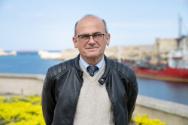
Oral history of the Malta Dockyard: Martin Vella
Interviewee
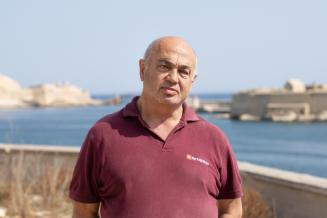
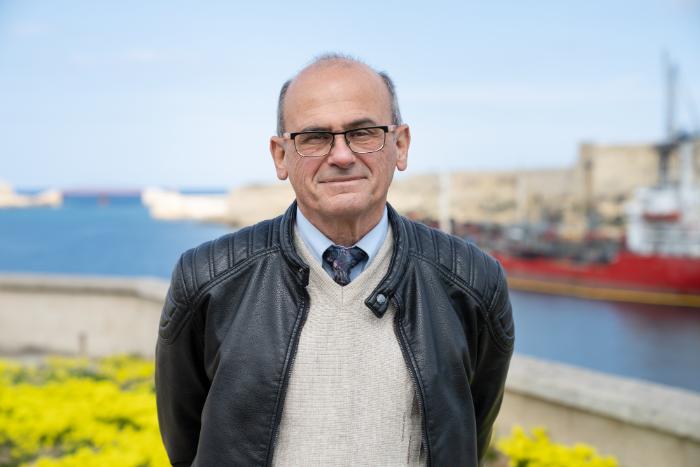
Martin Vella
Maltese, born 1954
Interviewed by
Joe Meli
Maltese, born 1953
Date4 May 2021
Classification(s)
Object TypeOral history
LanguageMaltese
Extent1 digital audio recording (WAV)
Registration NumberMMM.AV0032
DescriptionThis recorded interview was made as part of the Malta Dockyard Oral History project by the Digitisation Unit, Heritage Malta, under the direction of Joe Meli. Martin joined the yard in 1971 as an electrical fitter. On completion of his apprenticeship, he was assigned to the Electronics section. In 1989, he was promoted to deputy manager of the department, and eventually, in 1994, he became an electronics manager till the day he resigned in 2000, when he started working with another company.Transcript / Summary
(This summary is a work in progress. Timings are approximate.)
Special CollectionEducation-Dockyard school
(00:30) Entered the dockyard at the age of 17, after he had finished secondary school-Naxxar, Technical Institute-having six O’levels, which at the time having was quite a good level, especially considering that up to some years before, three O’levels was enough to study for a teacher department where he stayed throughout his career in the dockyard.
Education-Dockyard school
(01:30) He chose the electrical trade as an apprentice but since he has the physics O’level he went to a technical institute where he took industrial electronics classes and got qualified, hence, his apprenticeship was four years. After his apprenticeship, he was assigned to work with the electronics department where he stayed throughout his career in the dockyard.
(02:30) In 1989, he was promoted to deputy manager of the department, and eventually, in 1994, he became an electronics manager till the day he resigned, in 2000, when he started working with another company.
Education-Dockyard school
(03:15) As an apprentice, they worked the morning shifts, even though in the first year they were in the training centre, where they learned about the different trades within the dockyard. The next three years, he went to the different electrical sections within the dockyard, such as the machine shop, electrical fitters; afloat section, electrical shop and the drawing office-which was all done during the morning shift, starting at 6:30 till 15:15. Then, he went for a part-time course at the technical institute after work. In 1975, he became a tradesman, assigned with the electronics department.
(05:00) The electronics department, was the successor of the gunnery control section (also referred to as the radio shop) from the time of the Admiralty, when naval vessels required full overhaul and refurbishing of all the electro-mechanical equipment.
He does not recall this kind of work as it was before his time.
Entering the dockyard-Dockyard layout
(06:15) This department was divided into four specialized sections; each crucial for the repair of the vessel, especially when it came to certain survey certificates for classification purposes for certain repaired equipment such as radars, control panels, and navigation equipment.
The first section was in charge of the magnetic compass adjustment, which even though it did not have electronic elements, was crucial for the navigation systems. For the purpose of this section, the dockyard sent two personnel to study in a nautical school in England. The Magnetic compass adjustment was done after repairs and replacement of steel structures which affected the vessel’s magnetic compass. This was a classification certification requirement.
Entering the dockyard-Dockyard layout
(09:15) The second section dealt with wireless electronics such as radars and radios. The dockyard was a southern European representative for the main manufacturers of this equipment. The yard technicians were sent for training to these brands for qualifications and certification purposes. This service was offered to all ships calling Malta.
Entering the dockyard-Dockyard layout
(11:15) The third section was dedicated to the repairs of gyro compasses and autopilots. The gyro compasses work on a physical law, which is different from magnetic compasses. They also used to send technicians abroad regularly, to different manufacturers to keep abreast with the development of this equipment and act as authorised representatives including storage of spares.
Entering the dockyard-Dockyard layout
(12:45) The last section, which was the one he worked in, which was responsible for the control systems on a ship, such as alarms, control systems, and automation for the main engine; alarm and control systems for generators; alarm and control systems for boilers (mainly for steamships); wired navigation system such as echo sounder, speed logs, fire detection system and related electronic systems.
The above-mentioned services (for each section), were also offered outside the dockyard. In addition to the above, services offered in the last section were used also for electronics used within the dockyard such as various workshop machines, cranes, and dock gates.
Entering the dockyard-Swan Hunter / Bailey / changeovers
(16:30) In the beginning of the 1990s, during the restructuring of the dockyard, an instrument shop was added to the electronics department. This was due to advances in technology, such as analogue meters and pressure gauges, which at the time were new in our country and only done at the dockyard before Malta joined the EU and things such as ISO requirements. In fact, one of the main clients of the instrument shop was Air Malta. They sent maintenance instrumentation to be certified.
Education-Projects
(18:45) Projects-He recalls various vessels having fire damage in the engine room or a fire-damaged superstructures, where all the wiring and cables needed to be traced, cutting and renewing the burned parts. Moreover, these vessels had a limited time in the dockyard, so there was always a lot of pressure to complete the work in the shortest time possible.
(20:00) One of the last works that he was involved with was on the profile cutting machines of the plate shop. After 30 years of use on various projects such as new building of ships, the decision was to convert these cutting machines to work with a numerical controlled system.
(22:00) He was also involved in the conversion of the galvanizing plant. This was installed during the Admiralty, and was an important equipment required by the yard to galvanize pipes and other structures as a protection against corrosion. At the beginning of 1980s, it was still working using valves, so the yard bought new equipment from an English company. Martin was responsible to for installing the electrical and electronic components for the system.
(24:00) When he was working as a technician, during the late 1970s and 1980s, it was necessary for them to have drawings of the control systems, which were hard to find and different for each vessel.
Another alternative to obtain drawings, was through telex communications by asking details to the manufacturers of the equipment. This was a long process, and considering the limited time that ship stayed in the yard, they still had to work and solve problems even before these drawings became available.
They also communicated using radios when it came to navigation, which was a hassle depending on which place you were situated. Hence, he saw technology change over time and how it made certain processes more efficient.
(29:15) The electronics shop was situated near the training departments until the electrical complex was built.
(31:30) To this day, he is thankful for his experience within the dockyard because it taught him various useful skills which came in handy for his future work within a private company. Furthermore, his job after the dockyard was with a pharmaceutical company, and since it has been very important in our country, his knowledge is still being transferred which makes him proud of it.
Malta Dockyard Oral History project
Dimensions33 minutes 37 secondsProvenanceRecorded by Digitisation Unit, Heritage Malta.Online Collections
Public Access
Not on viewMuseumMalta Maritime Museum
Location
- Malta Maritime Museum, Reserve Collection